

A New Star in Ophiuchus
First spotted in Europe on October 9, 1604, this brilliant point of light appeared in the constellation Ophiuchus, the 'serpent-bearer'. It quickly grew to outshine Jupiter, becoming one of the brightest objects in the night sky. For several weeks, it was
even visible during the daytime. This 'stella nova', or new star, caused a sensation. At a time when the heavens were believed to be perfect and unchanging, its sudden appearance was a profound mystery that sparked debate across Europe and beyond. It was, in fact, the last supernova to be seen with the naked eye in our own Milky Way galaxy.
Enter Johannes Kepler
Though he wasn't the first to see it, the new star would become inextricably linked with German astronomer Johannes Kepler. Working as the imperial mathematician in Prague, Kepler began his own meticulous observations on October 17. Over the next year, he tracked its position and fading brightness. In 1606, he published his findings in a book titled 'De Stella nova in pede Serpentarii' ('On the New Star in the Foot of the Serpent-Bearer'). His detailed work provided a crucial scientific record of the event and ensured his name would be forever associated with the supernova.
What Observers Actually Saw
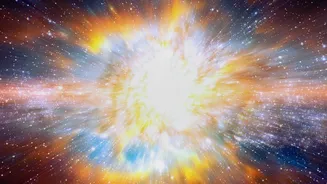
What Kepler and his contemporaries witnessed was not the birth of a star, but the violent death of one. Modern astronomers have identified SN 1604 as a Type Ia supernova. This type of cataclysmic explosion happens in a binary star system, where two stars orbit each other. It occurs when a dense, compact star called a white dwarf pulls too much material from its companion star, or merges with another white dwarf. This added mass triggers a runaway thermonuclear explosion, obliterating the star and blasting its material into space at incredible speeds.
The Supernova's Modern Legacy
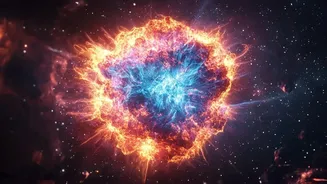
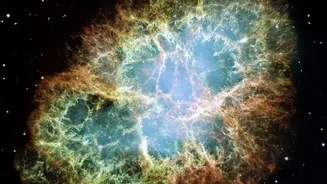
Today, more than four centuries later, the event known as Kepler's Supernova remains a vital subject of study. While the star itself is long gone, its aftermath—an expanding cloud of gas and dust called a supernova remnant—can be seen with powerful modern telescopes. NASA's Great Observatories, including the Hubble Space Telescope and the Chandra X-ray Observatory, have produced stunning multi-wavelength images of this remnant. These images reveal a complex, bubble-shaped structure about 14 light-years wide, expanding at millions of miles per hour. The remnant is located roughly 13,000 to 20,000 light-years from Earth.
A Cosmic Laboratory
By studying the different types of light—from X-rays to infrared—emitted by the remnant, astronomers can piece together the story of the explosion. The observations reveal shells of superheated gas, iron-rich material from the star's core, and a shock wave slamming into surrounding interstellar dust. Studying Kepler's supernova remnant helps scientists better understand the physics of Type Ia supernovae. These explosions are particularly important because they are used as 'standard candles' by astronomers to measure distances across the universe and study its accelerating expansion.