


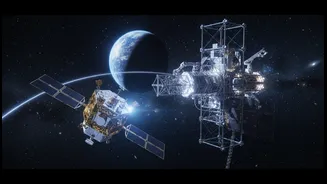



Validating a New Gateway to the Moon
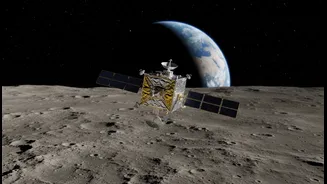
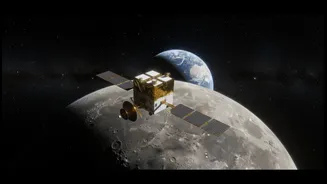
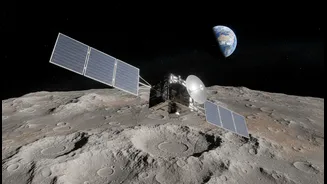
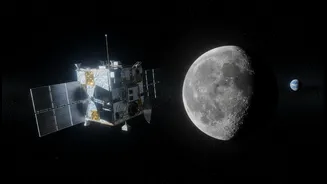
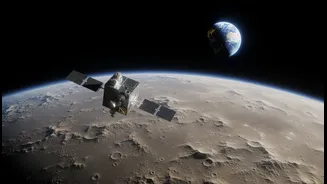
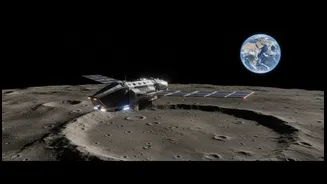
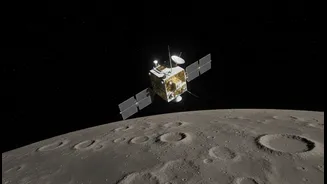
The primary goal of the CAPSTONE mission was to test and characterize a unique cislunar orbit known as a Near-Rectilinear Halo Orbit (NRHO). This highly elliptical path, which uses the combined gravity of the Earth and Moon, requires significantly less
fuel for a spacecraft to maintain its position. For engineers, this is a game-changer. CAPSTONE became the first spacecraft to fly in this orbit, successfully confirming the power and propulsion models that were previously only theoretical. The mission demonstrated that the NRHO is a stable and viable location for the future Gateway space station, a critical component of NASA's Artemis program that will serve as a staging point for crewed missions to the lunar surface. The stability of this orbit, validated by CAPSTONE, reduces long-term fuel requirements, making sustained lunar presence more feasible.
Proving Autonomous Navigation in Deep Space
Perhaps the most significant technological leap demonstrated by CAPSTONE was the Cislunar Autonomous Positioning System (CAPS). This system is designed to allow a spacecraft to determine its own position and trajectory without relying on constant instructions from Earth-based ground stations. CAPS functions by communicating directly with other lunar spacecraft, in this case, NASA’s Lunar Reconnaissance Orbiter (LRO). By sending signals back and forth, CAPSTONE was able to calculate its position relative to LRO, proving the concept of a peer-to-peer navigation network at the Moon. For future mission architects, this is a critical step toward creating a more autonomous, resilient, and less Earth-dependent infrastructure for the growing number of missions planned in the cislunar environment.
Lessons in Resilience: Overcoming On-Orbit Anomalies
The mission was not without its challenges, providing crucial, hard-won lessons in spacecraft operations. Shortly after launch, CAPSTONE experienced an anomaly that sent it into an uncontrolled spin, threatening the mission. Mission operators traced the issue to a partially open valve on a thruster. Through painstaking analysis, the team developed and executed a recovery plan that successfully regained three-axis control of the microwave-oven-sized spacecraft. Later in the mission, the craft again demonstrated its resilience by recovering from a separate communications issue using its on-board fault protection system. These incidents, while stressful, provided invaluable practical experience in diagnosing and recovering from complex problems in deep space, lessons that are now being incorporated into future mission designs and operational procedures.
The Value of an Extended Mission
After successfully completing its six-month primary mission, NASA extended CAPSTONE's operations, transforming the spacecraft into a flexible and cost-effective testbed. This extended phase allowed for further testing of advanced technologies without the expense of launching a new satellite. The team used this time to experiment with software-defined infrastructure, demonstrating that an operational spacecraft's hardware could host new applications uploaded after launch. One key experiment involved delay/disruption tolerant networking (DTN), a communication protocol designed for deep space that stores data when a connection is lost and automatically forwards it when the link is re-established. This successful demonstration is a vital proof-of-concept for ensuring reliable data transmission in the challenging lunar environment.
Practical Takeaways for Engineers
The CAPSTONE mission offers several concrete takeaways for the space and engineering communities. First, it proved that small, relatively low-cost CubeSats can serve as effective pathfinders for large, complex programs like Artemis. Second, the success of the autonomous CAPS navigation system highlights the shift toward more independent and interconnected space assets. Third, the mission's in-flight recoveries underscore the importance of robust fault-detection and recovery systems in spacecraft design. Finally, the extended mission proved the value of using existing space assets as testbeds for new software and technologies, a model that promises to accelerate innovation in a more cost-effective manner. The data from CAPSTONE will continue to be analyzed, directly informing the design and operation of the next generation of lunar explorers.