





The Initial Sighting
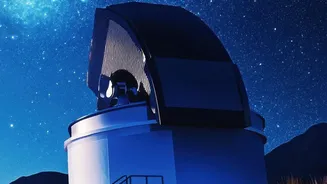
The hunt begins with wide-field survey telescopes that scan the sky nightly. Projects like the Catalina Sky Survey and Pan-STARRS take a series of images of the same patch of sky, minutes apart. Automated software then compares these images, looking for
any object that moves against the backdrop of fixed stars. If a moving dot doesn't match any of the millions of known objects in the official database, it’s flagged as a potential new discovery. This is the first clue in a celestial detective story.
The Global Coordination Centre
Once a potential new object is flagged, its position and time of observation are sent to a single, crucial hub: the Minor Planet Center (MPC). Operated under the authority of the International Astronomical Union, the MPC is the world's official clearinghouse for all observations of asteroids and comets. The center quickly publishes the data on its Near-Earth Object Confirmation Page (NEOCP). This acts as a global alert, telling astronomers worldwide, "We've found something new. We need more eyes on it, and fast."
A Race for Follow-Up Observations
The initial observations only provide a very short arc of the asteroid's movement. This isn't enough to determine its full path, and the object can easily be lost. A global network of astronomers, both professional and amateur, springs into action. Using the coordinates from the MPC, they point their telescopes to the predicted location to make 'follow-up' observations. The goal is to capture the object over two or three successive nights. These additional data points are critical for extending the arc and beginning to calculate a preliminary orbit.
Calculating the Preliminary Orbit
With at least three distinct observations, mathematicians can start to calculate the object's orbit. They find the elliptical path around the Sun that best fits the observed positions. This process, known as orbit determination, is complex; it must account for Earth's own movement, as the observer is on a moving platform. The initial orbit is just an estimate. But it’s enough for the MPC to officially recognize the object, remove it from the confirmation page, and give it a provisional designation, signaling its entry into the catalogue of known solar system bodies.
Assessing the Risk
As soon as a preliminary orbit is available, systems at NASA and the European Space Agency get to work. NASA's Sentry system at the Center for Near-Earth Object Studies (CNEOS) and ESA's similar programs project the orbit forward for the next 100 years or more to see if it will intersect with Earth's orbit. Initially, the uncertainty is high, and many newly discovered asteroids appear on these risk lists. This doesn't mean they are a definite threat, but that more data is needed to rule out an impact.
Long-Term Monitoring and Refinement
The work doesn't stop once an asteroid is catalogued. Over the following weeks, months, and even years, astronomers continue to make observations whenever the asteroid is visible. Each new data point helps to refine the orbit, shrinking the cone of uncertainty about its future path. For near-Earth objects, radar observations can provide incredibly precise measurements of distance and velocity, further improving the orbit calculations. With a more refined orbit, most objects are quickly removed from the risk list as future impacts are ruled out.