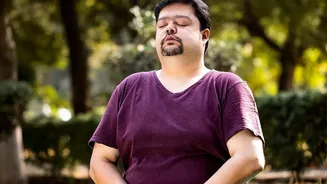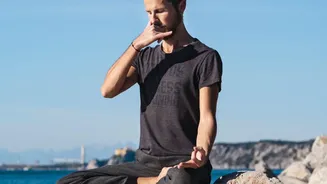





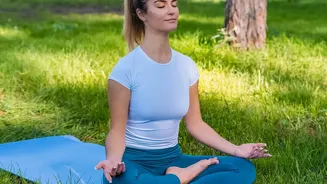
Why Your Breath is a Superpower
You breathe thousands of times a day without thinking, but when you pay attention, your breath becomes a powerful tool. When you feel stressed or anxious, your breathing often becomes fast and shallow, which is part of the body's 'fight or flight' response.
This is driven by the sympathetic nervous system. However, by intentionally slowing and deepening your breath, you can activate the parasympathetic nervous system, also known as the 'rest and digest' system. This shift sends a signal to your brain that you are safe, helping to slow your heart rate, lower blood pressure, and reduce levels of stress hormones like cortisol. Think of it as a manual override for your body’s stress response, accessible anytime, anywhere.
The Foundation: Diaphragmatic (Belly) Breathing
Most people tend to breathe from their chest, taking shallow breaths. Diaphragmatic breathing, or belly breathing, is the foundation of almost all relaxation-focused breathwork. It engages the diaphragm, the large muscle situated below your lungs, allowing for fuller, deeper breaths. This technique helps strengthen the diaphragm and makes your breathing more efficient.How to do it:1. Find a comfortable position, either lying on your back with a pillow under your knees or sitting in a supportive chair.2. Place one hand on your upper chest and the other just below your rib cage, on your belly.3. Inhale slowly through your nose, focusing on letting your stomach expand and push your hand up. The hand on your chest should remain as still as possible. Imagine you are filling a balloon in your stomach.4. Exhale slowly through your mouth with pursed lips, feeling your stomach gently fall as the hand on it lowers.Try this for 5-10 minutes a day to get comfortable with the sensation.
For Rhythm and Focus: Box Breathing
Also known as square breathing, this technique is used by everyone from athletes to Navy SEALs to stay calm and focused under pressure. Its simplicity is its strength, providing a steady rhythm that can interrupt anxious thought patterns and ground you in the present moment. The 'box' refers to its four equal sides, each representing a part of the breath cycle.How to do it:1. Sit upright in a comfortable chair with your feet flat on the floor.2. Exhale completely to a count of four.3. Inhale slowly through your nose for a count of four.4. Hold your breath for a count of four.5. Exhale slowly through your mouth for a count of four.6. Hold your breath again for a count of four before beginning the next cycle.Repeat this cycle for 3 to 5 minutes, focusing on the even rhythm of the count.
For Deeper Calm: The 4-7-8 Technique
Popularized by integrative medicine specialist Dr. Andrew Weil, the 4-7-8 breathing technique is a powerful tool for promoting calm and can be particularly useful when preparing for sleep. It is based on ancient yogic practices of pranayama. The key to this exercise is the extended exhale, which strongly stimulates the parasympathetic nervous system to encourage relaxation.How to do it:1. Sit or lie in a comfortable position. Place the tip of your tongue against the ridge of tissue just behind your top front teeth and keep it there.2. Exhale completely through your mouth, making a 'whoosh' sound.3. Close your mouth and inhale quietly through your nose to a mental count of four.4. Hold your breath for a count of seven.5. Exhale completely through your mouth, making the 'whoosh' sound again, for a count of eight.This completes one breath. Repeat the cycle for a total of four breaths to start. You might feel a little lightheaded at first, which is normal.
Making It a Habit
The benefits of breath-awareness exercises grow with consistent practice. You don't need to set aside an hour a day; starting with just five minutes can make a difference. Try incorporating these exercises into your daily routine. Practice belly breathing before you get out of bed in the morning or before you fall asleep. Use a few rounds of box breathing at your desk to reset during a stressful workday or before a difficult conversation. The goal is not to achieve a perfectly empty mind, but to gently guide your attention back to your breath whenever you feel overwhelmed. Over time, this practice becomes a reliable internal resource for finding a moment of peace, no matter what is happening around you.