




The Sun's Unpredictable Temper
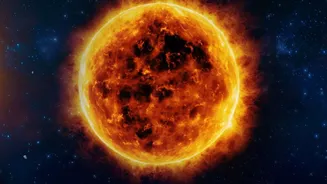
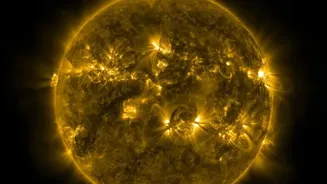
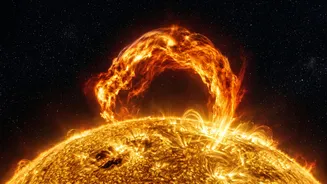
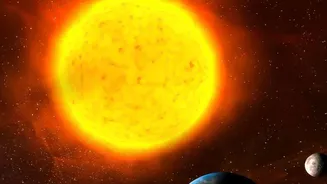
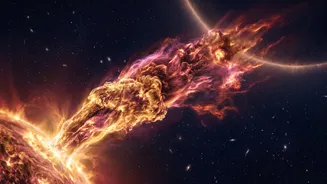
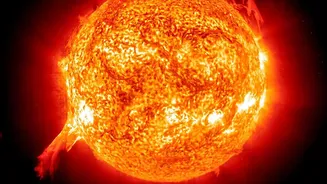
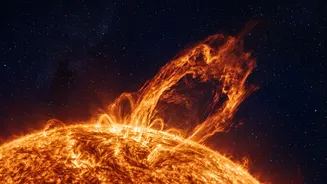
Space weather isn't about rain or snow; it's about the sun's activity. The main culprits are solar flares and Coronal Mass Ejections (CMEs). These events release massive bursts of radiation and charged particles that travel across space. While Earth's
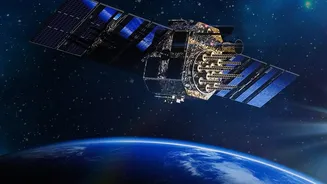
magnetic field protects us from most of this onslaught, a particularly strong storm aimed our way can have serious consequences. These storms can damage crucial satellites, disrupt GPS signals, trigger widespread power blackouts by overloading electrical grids, and interfere with radio communications used by airlines. In a world deeply reliant on technology for everything from financial transactions to navigation, these solar tantrums pose a significant and growing risk. The challenge has always been predicting when and where these storms will hit with enough time to prepare.
A Race Against Time
For years, forecasting space weather has been a reactive process. Scientists use satellites to watch the sun, but spotting a CME is often the start of a frantic race. By the time the eruption is seen, the clock is already ticking. Traditional models could offer some warning, but often without the precision or lead time needed for infrastructure operators to take meaningful preventative action. The goal has been to move from simply seeing a storm happen to accurately predicting its impact on Earth before it arrives. This is especially critical for protecting astronauts in space, who are outside much of Earth's protective magnetic shield, and for safeguarding the ever-growing number of satellites that power our global communication and navigation systems. A few hours, or even minutes, of advance warning could be the difference between a minor disruption and a catastrophic failure.
Enter the AI Forecaster: DAGGER
This is where artificial intelligence enters the picture. NASA has developed a groundbreaking AI model called DAGGER (Deep Learning Geomagnetic Perturbation). Instead of just watching the sun, DAGGER analyzes real-time data on the solar wind—the stream of particles constantly flowing from the sun—from various spacecraft. By training on vast amounts of historical data, the AI has learned to identify the subtle patterns in the solar wind that precede a geomagnetic storm on Earth. The result is a system that can predict where a solar storm will strike anywhere on the globe with 30 minutes of advance warning. While 30 minutes may not sound like much, it's a game-changer, providing a crucial window to protect vulnerable systems. The model can generate these highly specific predictions in less than a second and updates them every minute.
Why This Warning Matters for India
The impact of a major solar storm would be global, and India's rapidly growing digital economy and infrastructure are just as vulnerable. Our reliance on GPS for logistics and transportation, on satellites for communication and broadcasting, and on a stable power grid for our cities and industries means we have a vested interest in better space weather forecasting. An advance warning from a system like DAGGER would allow power grid operators to re-route power and protect transformers, satellite operators to put their spacecraft into a safe mode, and airlines to divert flights away from polar routes where radiation is highest. One of the lead authors on the paper announcing the DAGGER model, Vishal Upendran, is from the Inter-University Center for Astronomy and Astrophysics in India, highlighting the global and collaborative nature of this scientific endeavor.
The Future is Artificially Intelligent
DAGGER is just one example of how AI is becoming an indispensable tool for NASA. Another model, a collaboration with IBM called Surya, aims to predict the emergence of solar flares up to two hours before they happen by analyzing high-resolution images of the sun's surface. By processing enormous datasets far beyond human capacity, AI can uncover hidden patterns and relationships. This allows for a shift from a reactive to a proactive stance on space weather. These AI-driven forecasts will not only protect our technology on Earth but will be absolutely essential for future human exploration of the Moon and Mars, where astronauts will be far more exposed to the harshness of space. As we venture further from our home planet, our ability to predict the sun's behaviour will be key to our survival.