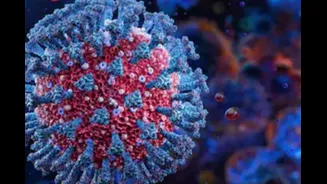







What is the PJ.2.1 Variant?
PJ.2.1 is a descendant of the JN.1 lineage of the SARS-CoV-2 virus. First identified in Ontario, Canada, in May 2026, it is what scientists call a 'saltation variant'. This means it has a large number of mutations, particularly on its spike protein, which
is the part of the virus that attaches to human cells. These genetic changes are why researchers are studying it closely, as they could influence how the virus behaves. While it has many mutations, PJ.2.1 has not yet been designated a 'variant of interest' or 'variant of concern' by the World Health Organization (WHO).
Where Has It Been Detected?
Since it was first found in Canada, PJ.2.1 has been identified in several other countries, including the United States, Australia, Singapore, Spain, France, Israel, and New Zealand. In some regions, like Ontario, it has shown signs of becoming more prevalent, accounting for a notable percentage of sequenced cases in recent months. Wastewater surveillance in the US has also suggested it is a fast-growing variant there. As of mid-November 2026, there has been no public confirmation of the variant's detection in India, but health authorities continue to monitor the situation through genomic surveillance.
Is It More Severe or Transmissible?
Currently, there is no evidence to suggest that PJ.2.1 causes more severe disease, higher rates of hospitalisation, or increased mortality compared to other circulating variants. Health experts stress the important distinction between a variant spreading faster and causing more serious illness. Some early lab studies suggest its mutations may help it bind more effectively to the ACE2 receptor, a protein that acts as a doorway into our cells. This could potentially give it a transmission advantage, but more real-world data is needed to be certain.
What Are the Symptoms?
The symptoms associated with PJ.2.1 are consistent with other recent COVID-19 variants and respiratory illnesses. These typically include fever, cough, a severe sore throat, runny or blocked nose, fatigue, headache, and muscle aches. The WHO has noted that the symptoms can strongly resemble those of the common cold or influenza, making it impossible to distinguish between them without a diagnostic test.
Do Vaccines Still Work?
Early laboratory findings are encouraging. Studies have found that PJ.2.1 does not seem to be substantially better at evading antibodies generated by updated vaccines compared to other recent variants. One study published in the 'Journal of Infection' noted that antibodies from vaccinated individuals were still effective at neutralizing PJ.2.1. While this is a positive sign, public health officials continue to stress that vaccination remains a critical tool for reducing the risk of severe disease, hospitalisation, and death from all forms of COVID-19.
What Is the Advice for the Public?
Health experts in India and abroad are advising caution but not alarm. The emergence of PJ.2.1 serves as a reminder that the virus is still circulating and evolving. Experts recommend following established public health guidance: wear a mask in crowded or poorly ventilated indoor spaces, practice good hand hygiene, and stay home if you feel unwell. For those who develop symptoms, especially individuals who are elderly or have underlying health conditions, it is advisable to test and consult a doctor. The key message is to remain informed through reliable sources and continue with sensible precautions.