


A New Star in the Heavens
In early October 1604, sky-watchers across Europe, China, and Korea noticed a brilliant point of light suddenly flare into existence in the constellation Ophiuchus, the 'serpent-bearer'. This 'guest star', as Chinese astronomers called it, was no ordinary
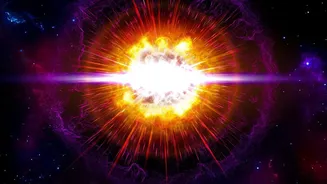
celestial event. It quickly grew in intensity until it outshone every star in the night sky and was even visible during daylight for more than three weeks. For 18 months, this mysterious visitor remained a fixture in the heavens, slowly fading from view but leaving an indelible mark on human history. This event, now known as Supernova 1604 or 'Kepler's Supernova', remains the most recent supernova to have been definitively observed with the naked eye within our own Milky Way galaxy.
The World Takes Notice
While observers across the globe recorded the event, it was the German astronomer Johannes Kepler who provided the most comprehensive study. He first saw the star on October 17 and was captivated. At the time, the prevailing scientific belief, inherited from the ancient Greek philosopher Aristotle, was that the realm of the stars was perfect and unchanging. A new star appearing in this supposedly immutable sphere was a direct contradiction of long-held doctrine. Kepler meticulously documented the star's position, its brightness, which he compared to other celestial bodies like Jupiter and Venus, and its colour, which he noted changed over time. His systematic observations were published in his book 'De Stella nova in pede Serpentarii' ('On the new star in the foot of the Serpent Handler').
Challenging an Ancient Worldview
Kepler's most critical contribution was his effort to measure the star's parallax—the apparent shift in its position when viewed from different locations. He found none. This was crucial evidence that the 'new star' was not a local atmospheric phenomenon but was located far away, in the distant realm of the fixed stars. This finding delivered a significant blow to the Aristotelian model of the cosmos and provided powerful supporting evidence for the sun-centered model proposed by Copernicus. The supernova became a focal point for debate, forcing a generation of thinkers to reconsider humanity's place in the universe. It demonstrated that the heavens were not static but were a dynamic and evolving environment.
What Science Tells Us Today
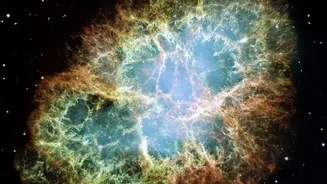
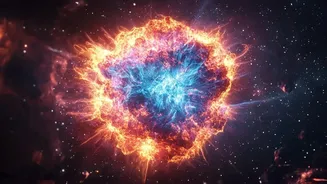
More than four centuries later, astronomers can point powerful telescopes toward the same spot in Ophiuchus to study the aftermath of that spectacular explosion. What remains is a beautiful, expanding cloud of gas and dust known as the SN 1604 remnant. Using modern instruments like NASA's Chandra X-ray Observatory and the Hubble Space Telescope, scientists have determined that Kepler's Supernova was a 'Type Ia' event. This occurs when a small, dense star called a white dwarf, part of a binary star system, siphons too much material from its companion star, triggering a cataclysmic thermonuclear explosion. By studying the composition and structure of the remnant, astronomers can learn more about the mechanics of these powerful explosions, which are used as 'standard candles' to measure cosmic distances.