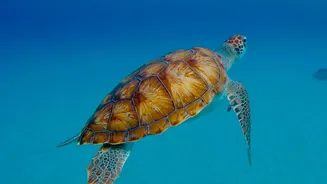




Imagine crossing an entire ocean and returning to the exact beach where you were born, all without a map or phone. For sea turtles, this isn't fantasy; it's instinct. Scientists have unravelled the secret to this incredible feat: an internal GPS.
An Innate Global Positioning System
Many
animals possess senses that humans can only dream of, but the sea turtle’s ability is truly extraordinary. They are equipped with a 'sixth sense' called magnetoreception, which allows them to perceive the Earth's magnetic field. This isn't just a simple compass pointing north; it functions as a sophisticated, two-part navigation system. By detecting variations in the magnetic field, a turtle can determine both its latitude and longitude, effectively giving it a 'magnetic address' anywhere on the planet. This allows them to embark on epic migrations, like the journey of a loggerhead turtle named Adelita who was tracked swimming 9,000 miles across the Pacific Ocean from Mexico to Japan.
Proving the 'Sixth Sense'
The idea that turtles use magnetism for navigation was once just a theory. The breakthrough came from years of research, most notably by biologists like Ken and Catherine Lohmann at the University of North Carolina. In a series of clever experiments, they placed loggerhead hatchlings in a large water tank surrounded by a computer-controlled coil system. This setup allowed them to replicate the magnetic field of any location on Earth. When they simulated the magnetic signature of a location along the turtles' natural migratory route, the hatchlings would instinctively swim in the direction that would keep them on course in the wild. For example, when exposed to the magnetic field found off the coast of Portugal, the turtles turned south to avoid being swept into dangerously cold northern waters. If the researchers reversed the field, the turtles would promptly swim in the opposite direction, proving their sensitivity to magnetic cues.
A Compass and a Map
The turtle's magnetic sense has two distinct components. The first is a 'compass sense', which tells them their direction (north, south, east, or west). The second, and more complex, is a 'map sense'. The Earth’s magnetic field isn’t uniform; it has two key properties that vary with location: inclination angle and intensity. Inclination is the angle at which the magnetic field lines dip toward the Earth's surface, providing a rough guide to latitude. Intensity, which is strongest near the poles and weakest at the equator, offers another piece of the positional puzzle. Together, these two variables create a unique magnetic signature for almost every point on the globe. By sensing this signature, a turtle can figure out where it is, not just which way it's heading. Research has shown that turtles have two separate sensory systems for these functions, as radiofrequency waves can disrupt their compass sense without affecting their map sense.
The Mystery of the Mechanism
While we know that turtles use this ability, the question of how their bodies physically detect magnetism is still an area of active research. One leading theory suggests that they have tiny magnetic particles, specifically a mineral called magnetite, in their cells. These particles may act like microscopic compass needles, twisting to align with the Earth's field and sending signals to the brain via the nervous system. Another hypothesis involves a quantum process in the turtles' eyes, where light-sensitive proteins might create chemical reactions that are influenced by the magnetic field, allowing them to 'see' it. Whatever the mechanism, it is clearly hardwired from birth. Studies have even shown that if turtle eggs develop in a distorted magnetic field, the hatchlings' navigational abilities can be impaired.
A Skill Crucial for Survival
This incredible navigational skill is essential throughout a sea turtle's life. As hatchlings, it guides them on their first multi-year journey around vast ocean gyres, like the North Atlantic gyre, helping them stay in warm, food-rich waters and avoid fatal cold. As they mature, turtles learn and remember the magnetic signatures of specific feeding grounds, allowing them to return to productive areas. But perhaps the most stunning use of this sense is for natal homing. It's believed that when a hatchling emerges from its nest, it imprints on the unique magnetic signature of that specific beach. Years later, after traveling thousands of miles, an adult female uses that imprinted magnetic address to navigate back to the very same stretch of coast to lay her own eggs, continuing a cycle that has unfolded for millions of years.