



The Living Wonders of Meghalaya
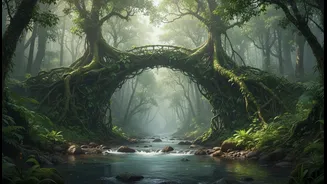
For centuries, the Khasi and Jaintia peoples of Meghalaya have practiced a unique form of bio-engineering. They guide the aerial roots of the rubber fig tree (Ficus elastica) across rivers and gorges, weaving them together to form sturdy, living suspension
bridges. Known locally as 'Jingkieng Jri', these structures take 15 to 30 years to mature but can last for centuries, growing stronger over time. They are a profound symbol of the symbiotic relationship between humans and nature, a philosophy deeply embedded in the local culture where people are seen as caretakers of the land, not its owners. These bridges are not just pathways; they are vital arteries connecting remote villages, with some of the roughly 100 known bridges spanning up to 250 feet.
A Heritage Under Pressure
Despite their resilience, the living root bridges face a host of modern threats. The knowledge of how to create and maintain them is fading with older generations. Modernisation has brought a preference for concrete and steel structures, which are faster to build but environmentally disruptive and prone to failure in the region's landslide-heavy environment. Unregulated tourism, while bringing income, puts immense physical strain on the bridges and surrounding ecosystems. In some cases, damage from tourism and other activities has led to these botanical marvels being replaced by conventional structures, accelerating the decline of the tradition. This combination of cultural erosion and environmental pressure has created an urgent need for concerted conservation efforts.
Enter Cultural Heritage Mapping
This is where the new generation comes in, armed with modern technology. Cultural heritage mapping is a field that uses digital tools to document, analyse, and preserve heritage sites. For the living root bridges, this means deploying technologies like Geographic Information Systems (GIS), 3D laser scanning, and photogrammetry to create high-fidelity digital models. These detailed models help researchers understand the bridges' structural mechanics, monitor their health, and assess risks from environmental changes. Institutions like the Wildlife Institute of India are offering courses that teach skills in geoinformatics and the mapping of heritage sites, specifically linking natural and cultural conservation. This technological approach provides a robust, scientific foundation for conservation plans, moving beyond anecdotal evidence to data-driven strategies.
A New Generation's Calling
So, why is this field so compelling for today's graduates? The attraction lies in its unique blend of purpose, technology, and tradition. For many young people disillusioned with conventional corporate career paths, this work offers a tangible and meaningful impact. It's a chance to be involved in a project that is both environmentally and culturally significant. The work is inherently interdisciplinary, combining ecology, engineering, anthropology, and data science. This allows graduates from diverse academic backgrounds to apply their skills in a real-world, problem-solving context. There is also a growing desire to connect with and learn from indigenous knowledge systems. The conservation of the root bridges is a collaborative effort, often led by community cooperatives, offering a model of partnership rather than top-down intervention. This combination of cutting-edge technology and ancient wisdom creates a career path that feels both innovative and deeply rooted.
The Road Ahead: Bridging Past and Future
The movement to conserve the living root bridges, now on UNESCO's tentative list of World Heritage Sites, is gaining momentum. The involvement of tech-savvy graduates is crucial for scaling these efforts. Their work in documenting the bridges provides invaluable data for securing formal heritage status and developing sustainable management plans. Furthermore, organisations like the Living Bridge Foundation are actively working to educate the Khasi community, especially young people, on the importance of reviving this art form. The challenge is to balance conservation with the economic needs of local communities, ensuring that tourism is sustainable and that the benefits are shared. Programs like the 'Guardians of the Living Bridges' employ local youth to monitor and maintain the structures, creating a direct link between conservation and livelihood.