




2001: A Space Odyssey (1968)
Stanley Kubrick’s masterpiece isn’t just a film; it's a piece of cinematic art that set the standard for every space movie that followed. Decades before CGI made anything possible, Kubrick’s team used pioneering practical effects, including detailed miniatures
and massive rotating sets, to create a vision of space travel that feels unnervingly realistic and timeless. The famous ‘Star Gate’ sequence, a mind-bending vortex of light and color created with experimental slit-scan photography, remains one of cinema's most powerful visual experiences. To watch '2001' on a massive screen is to witness the birth of the modern sci-fi blockbuster, with every meticulously composed shot designed for maximum awe and wonder.
Gravity (2013)
Few films have captured the terrifying beauty and isolation of space with the same visceral intensity as Alfonso Cuarón's 'Gravity'. Shot in long, seamless takes, the film plunges you into a zero-gravity environment where there is no up or down, only survival. The visual effects, led by Framestore, were so groundbreaking that they essentially had to invent new filmmaking techniques to achieve Cuarón's vision. On a huge screen, the experience is almost interactive. You feel every piece of debris whipping past, every desperate gasp for air, and every moment of breathtaking beauty as Dr. Ryan Stone (Sandra Bullock) floats against the backdrop of a silent, magnificent Earth. It's less a movie and more a simulation of being stranded in orbit.
Interstellar (2014)
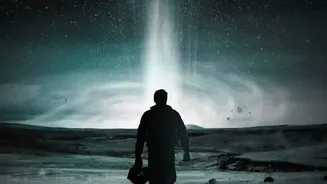
Christopher Nolan’s epic is as much a journey for the mind as it is for the eyes. In a quest to bring theoretical physics to life, Nolan collaborated with physicist Kip Thorne to create one of the most scientifically accurate depictions of a black hole in cinema history. The visualization of Gargantua, the spinning supermassive black hole, was based on Thorne's own equations and was so precise that it led to new scientific insights. The result is a cosmic light show that bends space and time before your very eyes. From the tidal wave planet to the eerie, silent beauty of space, 'Interstellar' fills the screen with sights that are both scientifically grounded and profoundly beautiful, making a large format essential to grasp its cosmic scale.
The Martian (2015)
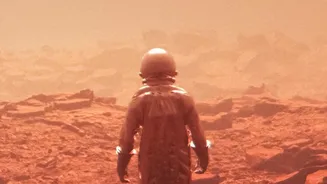
While some films explore fantastical galaxies, 'The Martian' finds its spectacle in the stark, desolate beauty of our celestial neighbour. Director Ridley Scott sought to create an authentic vision of Mars, moving beyond the 'boring, reddish ground' captured by rovers. Using high-resolution satellite imagery from NASA and filming in the stunning deserts of Jordan, the film presents vast, panoramic landscapes that make astronaut Mark Watney look tiny and utterly alone. The visual effects teams blended real-world photography with CG enhancements to create a Mars that felt both majestic and dangerous. The sweeping vistas of craters, mountains, and dust devils give the planet a distinct character, making it a crucial part of the survival story.
Dune (2021)
Denis Villeneuve’s 'Dune' is a masterclass in world-building on a scale seldom seen in cinema. While adapting Frank Herbert's dense novel was a challenge, Villeneuve focused on conveying the sheer, overwhelming magnitude of its universe. Everything is massive: the sandworms, the monolithic spaceships, the cavernous city of Arrakeen. The cinematography emphasizes this sense of scale, making human figures seem insignificant against the vast, spice-filled deserts of Arrakis. The film's visual language is brutalist and tactile, from the intricate designs of the Ornithopters to the imposing Harkonnen forces. It's a film designed to humble the audience, creating a tangible sense of a rich, ancient universe that truly comes alive on an epic screen.