


More Than Meets the Eye
The light our eyes can see is just a tiny sliver of the full range of light that exists, known as the electromagnetic spectrum. This spectrum includes everything from low-energy radio waves and microwaves to high-energy ultraviolet (UV) light, X-rays,
and gamma rays. For most of history, we could only study the universe through the narrow window of visible light. Today, modern telescopes allow us to observe the cosmos across this entire spectrum. This practice, called multiwavelength astronomy, is essential because different celestial objects and processes shine brightly in different types of light. What is invisible in one wavelength might be the most prominent feature in another.
A Cosmic Diagnostic Toolkit
Each wavelength gives astronomers unique information. Infrared light, for instance, can pierce through thick clouds of cosmic dust that would otherwise block our view, revealing newborn stars nestled inside. It also helps us see the universe's most distant galaxies, whose light has been stretched into the infrared part of the spectrum by the expansion of space. In contrast, high-energy X-rays and gamma rays are tell-tale signs of violent and extremely hot events. They point to supermassive black holes actively feeding on gas and dust, the remnants of exploded stars (supernovae), and high-speed particle jets moving at nearly the speed of light. Meanwhile, ultraviolet light highlights the hottest and most massive young stars, and radio waves map out clouds of cool hydrogen gas, the raw fuel for future star formation.
The Case of Centaurus A
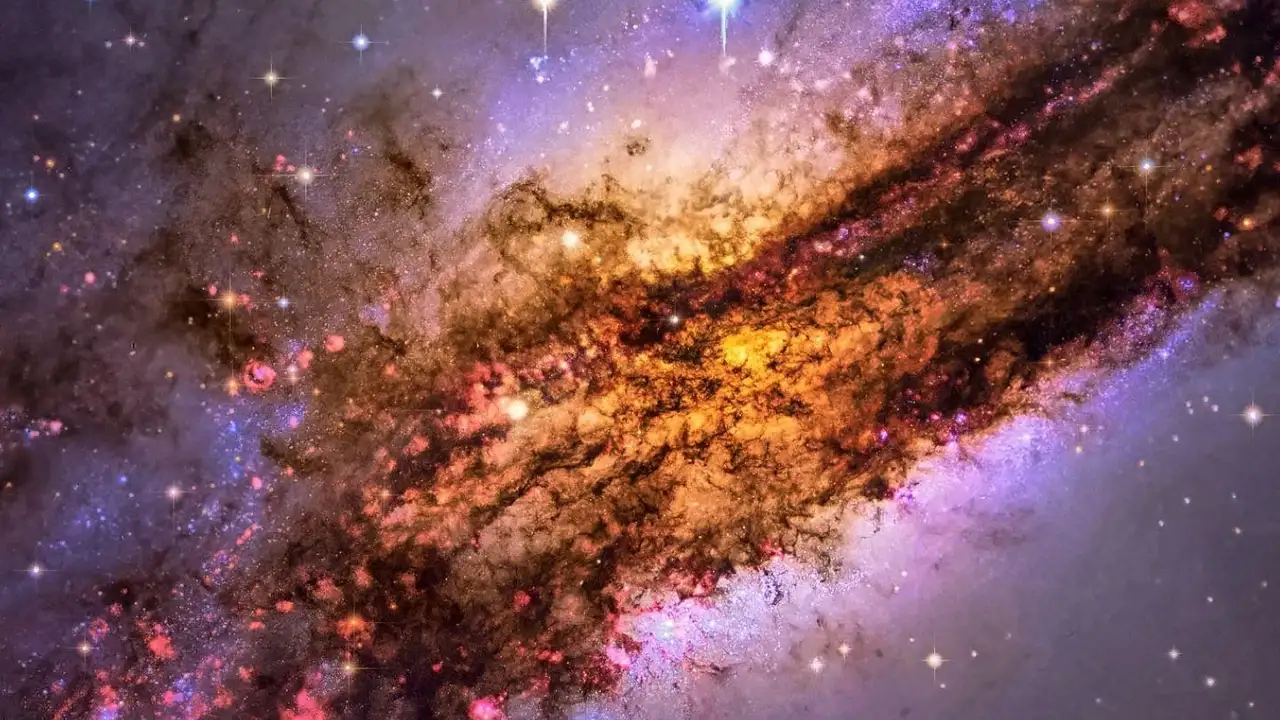
A perfect example of this technique in action is the galaxy Centaurus A, located about 12 million light-years away. In visible light, what we see is a large elliptical galaxy sliced in half by a thick, dark lane of dust. It looks like a collision in progress. But when we look again in other wavelengths, a more complete and dramatic story emerges. Infrared telescopes show that this dark dust lane is actually glowing brightly, warmed by clusters of young, hidden stars. In X-rays, we see the energetic region around the galaxy’s central supermassive black hole. Most strikingly, radio telescopes reveal enormous jets of material being blasted away from the black hole, extending more than a million light-years into space, far beyond the visible confines of the galaxy itself.
Telescopes Working in Concert
Piecing together this multiwavelength view requires a team of specialised observatories, both on the ground and in space. Earth's atmosphere blocks most high-energy radiation like X-rays and gamma rays, as well as some infrared and UV light, so we must send telescopes into orbit to see them clearly. Iconic space observatories like the Hubble Space Telescope (for visible and UV light), the James Webb Space Telescope (infrared), and the Chandra X-ray Observatory work together to capture these different cosmic perspectives. They are complemented by ground-based instruments like the Very Large Array (VLA) in New Mexico, which collects radio waves. By combining data from all these sources, astronomers can build a comprehensive portrait of a galaxy that is far richer and more dynamic than any single image could ever be.