
Mumbai to Goa: The Konkan Railway
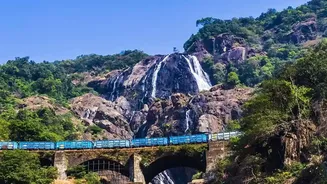
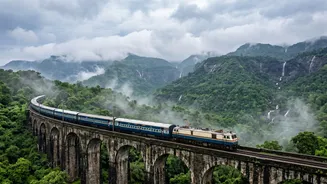
Often hailed as India's most cinematic monsoon rail route, the journey from Mumbai to Goa on the Konkan Railway is an experience in itself. This engineering marvel slices through the formidable Western Ghats, crossing over 2,000 bridges and passing through 92
tunnels. During the rains, from June to September, the route is at its dramatic best. The landscape erupts in shades of emerald green, and countless seasonal waterfalls appear, some gushing so close to the tracks you can feel their spray. The train winds through dense valleys where mist hangs heavy in the air, creating a surreal, dreamlike atmosphere. For many travellers, this journey, with its views of lush fields, swollen rivers, and the majestic Dudhsagar Falls at its peak, is a quintessential monsoon adventure.
Kalka to Shimla: The Himalayan Queen
A journey on the Kalka-Shimla Railway is like travelling back in time. This UNESCO World Heritage Site, built in 1903, is a narrow-gauge 'toy train' that slowly winds its way through the Himalayan foothills to the 'Queen of Hills', Shimla. While beautiful year-round, the monsoon adds a layer of mystical charm. The train navigates over 800 bridges and through 102 tunnels, with the surrounding pine and deodar forests appearing greener and more alive. Mist often blankets the valleys, creating breathtaking, picture-perfect scenes of the rain-washed Shivalik hills. The slow pace of the train allows you to fully absorb the serene, moody beauty of the mountains, though travellers should be aware that heavy rains can sometimes lead to delays or service suspensions.
Mettupalayam to Ooty: The Nilgiri Mountain Railway
Another UNESCO World Heritage Site, the Nilgiri Mountain Railway offers a nostalgic ride through the tea-covered hills of Tamil Nadu. The journey from Mettupalayam to the popular hill station of Ooty is particularly special during the monsoon when the landscape is a vibrant, lush green. This is the only rack railway in India, using a special toothed track to climb the steep gradients of the Nilgiri hills. The 'toy train' chugs through dense forests, past gushing waterfalls, and alongside sprawling tea estates often shrouded in a thick blanket of mist. The experience is a feast for the senses: the smell of wet earth and eucalyptus, the sight of unending greenery, and the rhythmic sound of the vintage locomotive making its steady ascent.
New Jalpaiguri to Darjeeling: The Darjeeling Himalayan Railway
The Darjeeling Himalayan Railway, affectionately known as the 'Toy Train', is one of India's most iconic mountain railways and a UNESCO World Heritage site. The route from the plains of New Jalpaiguri up to Darjeeling is an engineering marvel, famous for its tight loops and switchbacks, like the renowned Batasia Loop. During the monsoon, the journey is transformed into a passage through the clouds. The surrounding tea gardens and Himalayan forests become intensely green, and fog often reduces visibility, creating an ethereal and mysterious atmosphere. Watching the small train navigate the winding mountain roads, sometimes running parallel to traffic, offers a unique and unforgettable view of life in the Eastern Himalayas during the rainy season.
Through the Western Ghats: Karjat to Lonavala
For those seeking a shorter but equally spectacular monsoon journey, the route between Karjat and Lonavala in Maharashtra is a fantastic choice. This section is part of the main Mumbai-Pune line and climbs through the Bhor Ghat, offering some of the most dramatic scenery of the Western Ghats, especially during the rains. As the train ascends, passengers are treated to incredible views of deep valleys, dense fog, and numerous powerful waterfalls cascading down the rocky cliffs. The area becomes a haven for trekkers and tourists who come to witness the region's raw, rain-soaked beauty. The short journey is a powerful reminder of the monsoon's ability to completely transform a landscape into a lush, water-filled paradise.