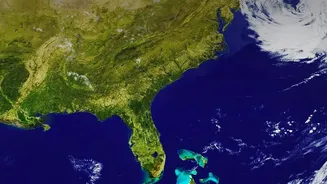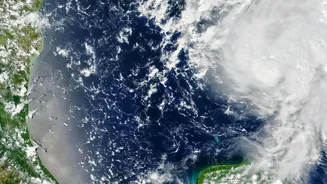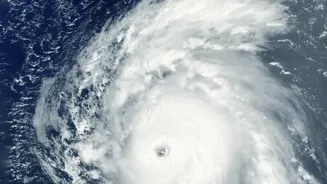




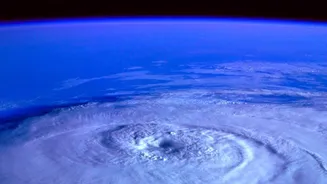

For India's vast and densely populated coastline, cyclones are a familiar and formidable foe. But what if the behaviour of these powerful storms was changing? Scientists are now studying long-term climate patterns that are rewriting the rules.
A Tale of Two Seas
The North
Indian Ocean, which cradles the subcontinent, is divided into two distinct basins: the Bay of Bengal to the east and the Arabian Sea to the west. Historically, the Bay of Bengal has been the far more active and dangerous of the two, generating about four cyclones for every one in the Arabian Sea. This is due to its unique shape, warmer surface temperatures, and its tendency to receive the remnants of storms from the Pacific. However, recent research indicates a significant and worrying shift in this long-standing pattern. While the Bay of Bengal remains a potent threat, the once-calmer Arabian Sea is waking up, showing a dramatic increase in cyclone activity.
The Engine Room of Climate Patterns
To understand why this is happening, scientists are looking at vast, slow-moving climate drivers that act like the ocean's engine. One is the Indian Ocean Dipole (IOD), a phenomenon involving a see-saw of sea surface temperatures between the western and eastern parts of the ocean. During a 'positive' IOD, the western Indian Ocean, including the Arabian Sea, becomes warmer than usual, providing extra fuel for cyclones. Another major factor is the Madden-Julian Oscillation (MJO), a massive eastward-moving pulse of cloud and rainfall near the equator. The MJO passes through the Indian Ocean every 30 to 60 days, and its active phases are known to create conditions ripe for cyclone formation by increasing moisture and reducing vertical wind shear.
Fewer Storms, but More Fury?
The headline question of frequency versus intensity is complex. While most studies suggest the overall number of cyclones forming in the Indian Ocean basin may not be increasing — and some models even project a decrease — there is a strong consensus that the storms that do form are becoming more powerful. The primary culprit is rising ocean heat. The Indian Ocean is warming faster than other tropical basins, and this additional thermal energy allows storms to strengthen significantly. Studies have noted a clear rise in the proportion of 'very severe' and 'extremely severe' cyclonic storms, which are Category 3 or higher. This means that while we may not see more storms overall, the likelihood of encountering a truly destructive one is going up.
The Alarming Rise of Arabian Sea Cyclones
The most pronounced change is occurring in the Arabian Sea. One study covering recent decades found a 52% increase in the number of cyclones in the Arabian Sea, an 80% increase in their total duration, and a staggering 150% increase in the frequency of 'very severe' cyclonic storms. The accumulated cyclone energy, a measure of the total wind energy over a cyclone's lifetime, has nearly tripled in the Arabian Sea. This has profound implications for India's west coast, including the states of Gujarat, Maharashtra, Goa, and Karnataka, which are less historically accustomed to and prepared for intense cyclones compared to their eastern counterparts.
India's Race to Adapt
These shifting patterns present a dynamic challenge for India's disaster management agencies. Thanks to incredible improvements in forecasting, satellite monitoring, and early warning systems led by the India Meteorological Department (IMD), the country has become remarkably successful at saving lives through mass evacuations. The response to Cyclone Fani in 2019, where over a million people were safely evacuated, stands as a testament to this progress. However, the increasing intensity and the phenomenon of 'rapid intensification'—where a storm can explode in strength in less than 24 hours—are shrinking response times. This puts immense pressure on infrastructure, from cyclone shelters and evacuation routes to resilient power and communication networks, which must be constantly upgraded to face a future of more powerful storms.