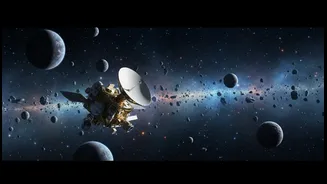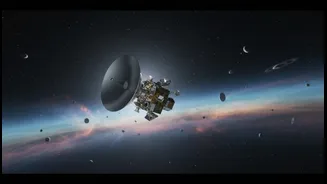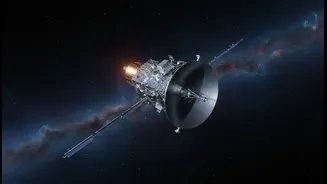








A Wake-Up Call from the Void
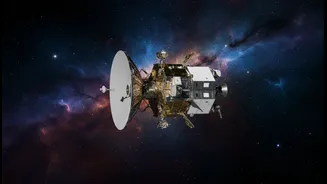
On July 7, 2026, engineers at the Johns Hopkins Applied Physics Laboratory (APL) confirmed they had received a signal from the New Horizons probe. It wasn't an unexpected call; the spacecraft was following commands sent nearly a year prior to awaken from a 321-day
hibernation period that began in August 2025. Due to its staggering distance in the Kuiper Belt, the region of icy bodies beyond Neptune, the signal took almost nine hours to travel to Earth. Mission Operations Manager Alice Bowman confirmed the spacecraft was in excellent health, with weekly status reports during its slumber all coming back “green.” This practice of hibernating is crucial for long-duration missions, conserving precious power from its nuclear battery and protecting its systems during the long cruise between objectives. While the main systems were asleep, several instruments continued to passively collect data, including sensors measuring solar wind and the dust environment of this remote region.
The Search for a New Destination
With the spacecraft awake and its instruments being checked out, the mission team is turning its attention to a monumental task: finding a new world to visit. This is the central challenge of the probe's current extended mission. After its historic flybys of Pluto in 2015 and a Kuiper Belt Object (KBO) named Arrokoth in 2019, New Horizons has enough fuel to potentially divert its course for one more close encounter. The problem? No suitable target has been found yet. The search is incredibly difficult. Scientists are looking for a small, dark object, likely only a few dozen kilometres across, in a vast and poorly mapped region of space. To find a KBO within range of New Horizons' limited fuel supply, researchers are scouring a narrow cone of sky along the spacecraft’s trajectory. They must find an object that is not only there but also reachable with carefully planned engine burns.
Telescopes, AI, and Charting a Course
Finding this cosmic needle in a haystack requires some of the most powerful tools on Earth. Astronomers are using world-class observatories, like the Subaru Telescope in Hawaii, to hunt for potential targets. The search is so demanding that the team has developed artificial intelligence and machine-learning algorithms to help them spot the faint, slow-moving signature of a distant KBO against a backdrop of countless stars. This is the same high-tech approach that successfully identified Arrokoth before the 2019 flyby. If a viable candidate is discovered, the process of planning the “new flight coordinates” will begin. This involves a series of precise, short thruster firings calculated to nudge the spacecraft's path over several years to intercept the target. Given the distances and timelines involved, any new flyby would likely not occur until the late 2020s or even into the 2030s.
What's Next for the Deep-Space Explorer
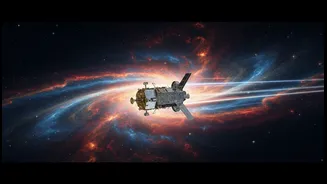
While the hunt for a third flyby target continues, New Horizons is far from idle. Now fully active, its primary role is to act as a unique observatory platform in the outer solar system. In the coming weeks, its Alice ultraviolet spectrograph will begin studying the distribution of hydrogen at the edge of the heliosphere—the protective bubble of particles generated by our Sun. This provides invaluable data on how the solar wind interacts with interstellar space, a task that only the Voyager probes have performed at such distances. The spacecraft is continuing its journey out of the solar system at a speed of about 480 million kilometres per year and has enough power to continue operating into the 2040s. Its instruments offer a modern, high-fidelity look at this frontier, complementing the legacy of its predecessors and paving the way for future interstellar missions.