



Flares vs. Giant Solar Burps
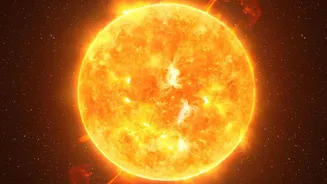
First, it's helpful to clear up some terms. The headline mentions solar flares, but the bigger threat that satellites give us significant warning for are Coronal Mass Ejections (CMEs). Think of it this way: a solar flare is like the bright muzzle flash
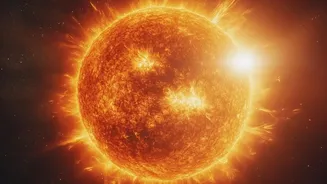
from a cannon—a brilliant burst of radiation that reaches Earth in about eight minutes. It can disrupt radio communications almost instantly. A CME, on the other hand, is the cannonball itself—a colossal cloud of magnetised plasma and particles blasted from the Sun's corona, its outer atmosphere. These CMEs travel much slower, taking anywhere from 15 hours to several days to cross the 150 million kilometres to Earth. It is this travel time that provides a crucial window for preparation, and seeing these CMEs leave the Sun is where coronagraphs shine.
The Art of the Artificial Eclipse
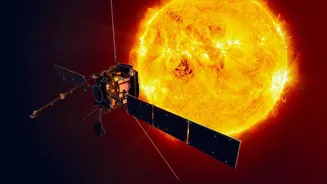
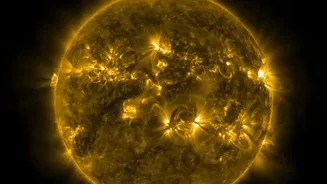
The Sun’s surface is so blindingly bright that it completely drowns out its much fainter, superheated corona. A coronagraph is a clever instrument designed to solve this problem by creating an artificial eclipse. Inside the satellite's telescope, a precisely engineered disc, called an occulting disk, blocks the direct light from the Sun's main body. This allows the telescope to capture detailed images of the surrounding corona, which is millions of times dimmer. By doing this continuously, scientists can watch the corona for signs of an eruption. When a billion-ton cloud of plasma bursts from the Sun, the coronagraph sees it happening. This technology was invented in the 1930s by Bernard Lyot for ground-based telescopes but is far more effective in space, above the light-scattering effects of Earth's atmosphere.
From Observation to Warning
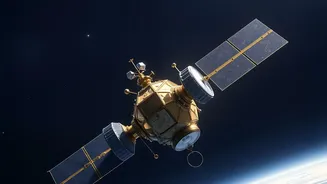
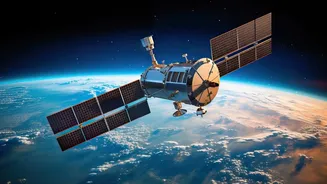
Spotting a CME is the first step. Satellites like the joint NASA/ESA Solar and Heliospheric Observatory (SOHO) and NOAA's newer GOES and SOLAR-1 satellites use their coronagraphs to take regular images of the corona. When a CME erupts, forecasters at agencies like NOAA’s Space Weather Prediction Center (SWPC) analyse a sequence of these images. They determine the CME’s size, speed, and direction to see if it’s headed for Earth. This initial detection from a coronagraph is what enables watches and warnings to be issued one to four days in advance. The fastest CMEs can arrive in under a day, while slower ones take several. This lead time is critical. For an even more precise, short-term warning, satellites like DSCOVR, parked a million miles from Earth, can directly sample the solar wind, providing a final 15- to 60-minute heads-up before the storm hits.
A Critical Window to Act
So, what can be done with a lead time of one to three days? Quite a lot. This warning gives critical infrastructure operators time to prepare. Power grid operators can take steps to protect transformers from damaging geomagnetic-induced currents. Satellite operators can put their spacecraft into a protective safe mode to prevent damage to sensitive electronics. Airlines can reroute flights away from polar regions where radiation exposure is higher during a solar storm. Even future crewed missions to the Moon and beyond rely on these warnings to keep astronauts safe. For the public, it’s a cue to ensure you have emergency plans, much like you would for a terrestrial storm, as severe events could potentially disrupt power and communications.