



The Sound of Electronic Silence
Imagine trying to hear a pin drop during a rock concert. That’s the fundamental challenge facing missions like NASA's Nancy Grace Roman Space Telescope. Every electronic component on a spacecraft—from its power systems and communication arrays to its scientific
instruments—generates a faint electromagnetic field, a kind of electronic hum. This phenomenon is known as Electromagnetic Interference (EMI). When you have dozens of these systems crammed into a single vehicle, there's a serious risk they will 'talk over' each other. For a telescope designed to detect the faintest whispers of light from billions of light-years away, this internal chatter can be catastrophic. The scientific data would be contaminated with noise, effectively blinding the very instrument built to see the universe with unprecedented clarity.
A Telescope at War with Itself
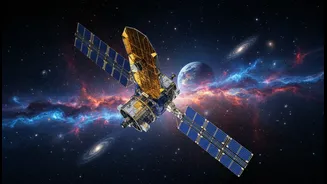
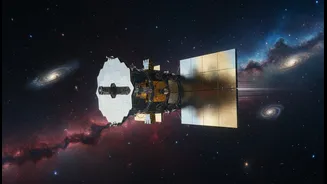
The Nancy Grace Roman Space Telescope, slated to launch in the near future, is a prime example of this high-stakes balancing act. Its Wide Field Instrument (WFI) is a 300-megapixel infrared camera so powerful it can capture a field of view 100 times larger than Hubble's. It will hunt for clues about dark energy and discover thousands of new exoplanets. Alongside it is the Coronagraph Instrument, a technology demonstration designed to block the overwhelming glare of a star to directly image the faint planets orbiting it. But for these revolutionary instruments to work, they can't be disrupted by the spacecraft's own guidance computers, radio transmitters, or power distribution units. Every single wire and circuit board must be designed for Electromagnetic Compatibility (EMC), ensuring it neither emits harmful interference nor is susceptible to the noise from its neighbours. It's a massive, intricate puzzle where one misplaced source of electronic noise could jeopardise the entire multi-billion-dollar mission.
Inside the Quiet Chamber
So, how do engineers ensure this electronic harmony? The answer lies in painstaking and rigorous testing on the ground. Before a component is ever integrated into the spacecraft, it spends time in a specialised anechoic chamber. These rooms are bizarrely futuristic, lined with sharp, foam pyramids designed to absorb all stray radio waves, creating an environment of pure electromagnetic silence. Inside this quiet room, engineers deliberately blast the instrument with a barrage of radio waves across a wide spectrum of frequencies. This process tests the instrument’s resilience, or 'susceptibility', to interference. They also use hyper-sensitive antennas to listen for any unintended 'emissions' the component might be radiating. This meticulous process is repeated for every major piece of hardware, from individual circuit boards to the fully assembled instruments, to guarantee that when they are all switched on millions of miles from Earth, they operate in perfect, silent concert.
A Growing Universe of Noise
Solving for internal interference is only half the battle. Astronomers are facing a growing, external threat from the proliferation of large satellite constellations in low-Earth orbit, such as Starlink. While these networks provide global internet access, their satellites emit unintended radio signals from their onboard electronics. This leakage radiation creates a persistent source of noise that can contaminate observations from both ground-based and space-based telescopes. Researchers have found this interference can affect a significant percentage of astronomical images, creating bright streaks and polluting the specific radio frequencies reserved for scientific discovery. This means that even if a mission like the Roman Space Telescope achieves perfect internal harmony, its view of the cosmos is increasingly obscured by a human-made cloud of electronic noise.