







The Most Dangerous Minutes
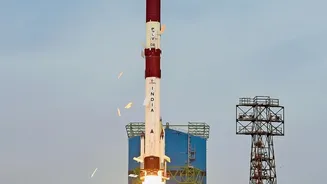
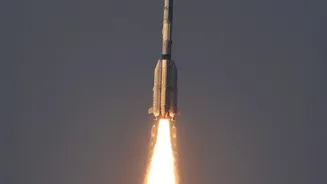
The most critical phase of any space mission is the launch. For several minutes, astronauts sit atop a controlled explosion, experiencing immense G-forces and aerodynamic stress as their vehicle claws its way to orbit. A booster anomaly—an unexpected
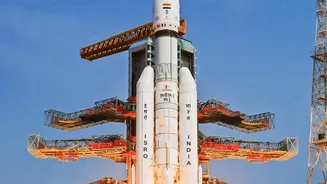
malfunction in the powerful rockets providing thrust—can happen in seconds. Gaganyaan's launch vehicle, the HLVM3, uses two massive solid-fuel boosters. Unlike liquid-fuelled engines that can be shut down, once these solid motors are ignited, they burn until their fuel is spent. This makes it impossible to simply turn off a failing booster. If a critical failure occurs, the only option is to get the crew away from the malfunctioning rocket, and fast.
The Guardian Angel: Crew Escape System
Enter the Crew Escape System (CES), Gaganyaan's guardian angel. This system is a dedicated safety mechanism designed for one purpose: to pull the crew module, containing the astronauts, away from the rocket in case of a catastrophic failure during launch or ascent. Mounted at the very top of the rocket, the CES is essentially a lifeboat for the sky. Its job is to rapidly separate the crew's capsule and propel it to a safe distance, allowing for a controlled descent and splashdown. This entire sequence must happen in milliseconds, demanding a system that can react faster than the unfolding disaster below.
Anatomy of an Escape
The Gaganyaan CES is a 'puller' type system, similar to those used on the historic Apollo and Soyuz missions. It consists of a tower-like structure fixed to the crew module, packed with a set of powerful, quick-acting solid motors. These aren't ordinary rocket motors; they use high burn-rate propellants designed to generate immense thrust almost instantly. If the onboard health monitoring system detects a severe anomaly, it automatically triggers the CES. The escape motors fire with a force capable of producing up to 10 times the force of gravity, violently yanking the crew module clear of the failing launch vehicle. This extreme acceleration is survivable for the astronauts, who are positioned in specially designed seats to withstand the forces.
High-Altitude vs. Pad Abort
The system is designed to work in different scenarios. A 'Pad Abort' would be used if an emergency occurs on the launchpad itself, before or during ignition. In this case, the CES fires to lift the crew module up and away from the pad. A 'High-Altitude Abort', as the headline suggests, deals with anomalies that occur after launch, when the rocket is already travelling at high speed through the atmosphere. This is a particularly challenging phase due to high structural loads and hypersonic speeds. The system has different motors for different altitudes, including the High-altitude Escape Motor (HEM), to ensure the crew can be pulled to safety at any stage during the ascent.
Proven Through Testing
This life-saving technology isn't just a concept on a blueprint. ISRO has rigorously tested the Crew Escape System to ensure its reliability. The Test Vehicle Abort Mission-1 (TV-D1), conducted in October 2023, was a landmark success. For this test, ISRO launched a specially designed test rocket to a high altitude. At a critical moment in the flight, controllers deliberately triggered an abort. The CES performed exactly as intended, pulling the uncrewed module away from the booster, deploying its parachutes, and splashing down safely in the Bay of Bengal. This successful test was a crucial validation, proving the system works under the precise, high-stress conditions it was designed for.