

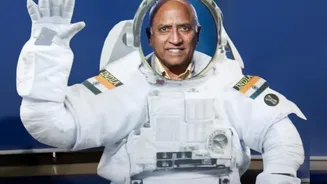

India’s Next Giant Leap
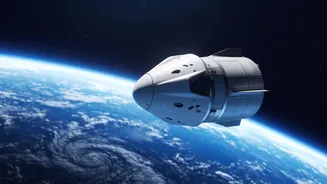
The Gaganyaan programme is one of India's most ambitious scientific endeavours, aiming to send a crew of three astronauts into a Low Earth Orbit of 400 kilometres for a three-day mission. A successful mission will make India only the fourth country in the world—after
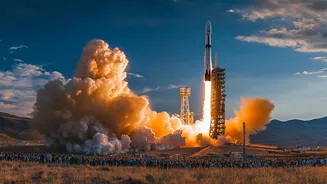
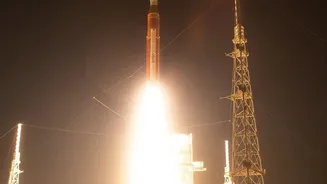
the United States, Russia, and China—to have an independent human spaceflight capability. But launching humans into the hostile environment of space is exponentially more complex and dangerous than sending satellites. The priority is not just mission success, but crew survival. This is why every component, every system, and every procedure must be tested to its limits on the ground and through a series of uncrewed flights before any astronaut boards the rocket. According to recent statements from ISRO, the first full uncrewed orbital flight, G1, is targeted for late 2026, with the first crewed mission, H1, planned for 2027.
Safety First, Mission Second
In human spaceflight, there are no second chances. Every system must have a backup, and every potential failure must have a corresponding safety protocol. ISRO is conducting thousands of tests to ensure the Gaganyaan mission is as safe as humanly possible. These range from subjecting components to extreme vibrations and temperatures to validating the complex software that will manage the flight. The most critical of these are the tests for the Crew Escape System (CES) and the Crew Module's landing and recovery systems. These are designed to protect the astronauts during the most dangerous phases of any mission: launch, ascent, re-entry, and splashdown. Recently in mid-2026, ISRO successfully completed three major qualification tests for the crew module related to its post-splashdown stability, the separation of its umbilical cord to the service module, and its structural strength during parachute deployment.
The All-Important Escape Plan
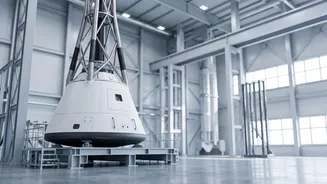
What happens if the rocket malfunctions on the launchpad or moments after liftoff? This is where the Crew Escape System (CES) comes in. It's essentially an ejector seat for the entire astronaut capsule. The CES is a dedicated rocket motor system designed to rapidly pull the Crew Module away from the main launch vehicle in an emergency. ISRO has planned a series of tests to validate this system under different scenarios. The first, a Pad Abort Test, was successfully conducted in 2018. In this test, the system fired its motors to pull a simulated crew capsule from the launchpad to a safe altitude, where it then deployed parachutes and splashed down in the sea. The next series of tests, known as Test Vehicle (TV) missions, will simulate an in-flight abort, where the CES must activate while the rocket is travelling at high speed through the atmosphere. The first such test, TV-D1, was successfully completed, and the next, TV-D2, is in advanced stages of preparation.
From Fiery Re-entry to a Safe Splashdown
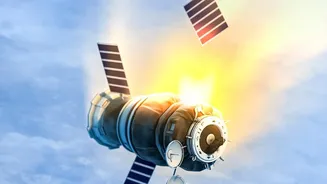
Getting to orbit is only half the journey. The uncrewed test flights will also validate the entire sequence of bringing the capsule home. After the orbital phase, the Crew Module separates from the Service Module and begins its fiery descent through Earth's atmosphere. The tests will ensure its heat shield can withstand the extreme temperatures of re-entry. Once it has slowed down, a complex sequence of parachutes must deploy perfectly to bring the capsule to a gentle splashdown in the ocean. ISRO has been conducting Integrated Air Drop Tests to qualify this multi-parachute system. Further recent tests have also qualified the Crew Module Up-righting System (CMUS), which uses gas-inflated floats to ensure the capsule stays upright after landing in the water, a critical step for the safe recovery of the crew.