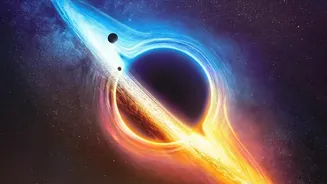




Black holes are famous for pulling things in, not breaking apart. But what if they could? A surprising new theoretical study has found a loophole in the laws of physics that suggests this might not be impossible under very specific conditions.
The Cosmic Rule-Benders
We usually
think of black holes as the ultimate cosmic vacuum cleaners, growing only by merging and swallowing matter. The idea of one splitting into two seems to violate our understanding of the universe. For a long time, physicists believed this was impossible due to a fundamental law involving entropy, a measure of disorder. For a standard, non-rotating black hole, splitting into two smaller ones would decrease the total entropy, which is a process that physics generally forbids. This has made the concept of black hole division a non-starter, until now. A new theoretical paper published in the journal 'Physical Review D' challenges this long-held assumption by exploring the strange physics at the edge of what's possible.
A Loophole for Spinning Black Holes
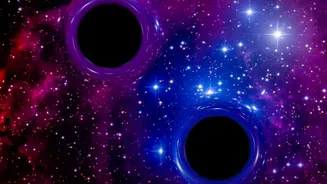
The international team of physicists behind the study found a potential exception to the rule: extreme rotation. According to their calculations, if a black hole spins at a speed close to its absolute maximum limit, the physics might change. Under these extraordinary circumstances, the process of splitting into two smaller black holes might not be thermodynamically forbidden after all. The conditions would have to be perfect. The newly formed black holes would need to fly apart fast enough to avoid immediately merging back into one. While this makes the event incredibly rare, the study concludes it is not completely ruled out by the laws of physics as we currently understand them.
Enter the Primordial Black Holes
While the giant black holes we observe today are unlikely candidates for splitting, the researchers suggest that another, more mysterious type might be more prone to it: primordial black holes (PBHs). These are hypothetical black holes believed to have formed in the chaotic, dense environment just moments after the Big Bang, long before the first stars. Unlike their stellar-mass cousins, which form from collapsing stars, PBHs could have a vast range of sizes, from as small as an asteroid to many times the mass of the Sun. Scientists believe these smaller, ancient black holes might be the most likely to achieve the extreme spin needed to become unstable and potentially split.
Why This Possibility Matters
Confirming that black holes can split would be more than just a cosmic curiosity. It could open up new avenues for understanding some of the biggest puzzles in astrophysics. For one, primordial black holes are a leading candidate for explaining dark matter, the mysterious, invisible substance that makes up about 85% of the matter in the universe. If PBHs can split, it would change our models of how they behave and how they might be distributed across the cosmos. Furthermore, observing such an event, perhaps through signals from tiny fragments, could give us a window into the behaviour of gravity under the most extreme conditions imaginable, potentially pointing the way toward physics beyond Einstein's theory of general relativity.
What Comes Next in the Search
It is important to stress that this is a theoretical study, not an astronomical discovery. No one has ever observed a black hole splitting. The authors themselves state they cannot yet assign a probability to such an event. However, their work provides a fascinating new target for astronomers. Future observations could look for indirect evidence, such as specific gravitational wave signals or gamma-ray bursts that might be produced by tiny black hole fragments. Observatories like NASA's Fermi Large Area Telescope could potentially search for these telltale signs. While the theory is mind bending, it reminds us that the universe may still have fundamental surprises waiting to be discovered, challenging our deepest assumptions about how it works.