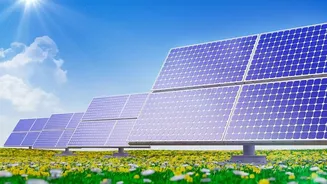




What Exactly Are Perovskite Solar Cells?
For decades, solar power has meant bulky, rigid silicon panels. They work well, but they are approaching their theoretical limits for efficiency. Perovskites are a different class of material with a specific crystal structure. Think of them as a newcomer
with astounding potential. These materials can be made into extremely thin, lightweight, and flexible films, which opens up a world of possibilities beyond traditional panels. The manufacturing process can be simpler and require less energy than producing high-purity silicon, hinting at a future of much lower costs. At their core, these cells use a perovskite-structured compound as the light-harvesting active layer to convert sunlight into electricity, just like silicon, but with some unique advantages.
The Big Promise: Higher Efficiency at Lower Cost
The two main factors holding solar back from true mass adoption have always been efficiency and cost. This is where perovskites get really exciting. While standard silicon cells have been topping out around 22-27% efficiency in commercial products, lab-tested perovskite cells are smashing records. The most promising application is in 'tandem' cells, where a thin perovskite layer is placed on top of a traditional silicon cell. The perovskite layer captures high-energy light (like blues and greens), while the silicon layer below captures the lower-energy light (like reds) that passes through. This one-two punch dramatically boosts overall performance. Recent records for these tandem cells have soared past 34%, a huge leap in the solar world.
The Challenge Holding Everything Back: Durability
If this technology is so great, why aren’t our homes already covered in it? The single biggest hurdle has been durability. Early perovskite cells degraded quickly when exposed to real-world conditions like moisture, heat, and even continuous sunlight. While a silicon panel is expected to last 25 to 30 years, early perovskites would lose performance much faster. This instability has made commercial manufacturers hesitant. However, recent breakthroughs are directly tackling this problem. Scientists are engineering new chemical compositions and using protective layers to make the cells more robust. Recent studies have shown new designs retaining a high percentage of their performance after prolonged stress tests, a major step toward commercial viability.
From the Lab to the Factory Floor
A record-breaking lab result is one thing; making millions of large, consistent panels is another. Scaling up production from small lab samples to factory-sized modules has been a significant challenge. Minor defects that are manageable in a tiny cell can ruin a large panel. Companies are now developing new manufacturing techniques like slot-die coating and advanced spray methods to create large, uniform perovskite films without sacrificing quality. In a major sign of progress, companies in the UK, China, and the US have started pilot production lines, shipping the first commercial-grade tandem panels for real-world testing in utility-scale projects. This is the crucial phase where the technology must prove it can be made reliably and at scale.
What This Means for India
The potential for India is immense. Indian researchers are actively contributing to this global push. Teams at institutions like IIT Bombay have achieved remarkable results, developing tandem cells with efficiencies nearing 30%. One Indian company, P3C, has described itself as the nation's first perovskite solar manufacturer, with ambitious plans for gigawatt-scale capacity. For a country with ambitious solar energy goals, a cheaper and more efficient domestic solar technology could be transformative. It could lower the cost of large-scale solar farms and, as the headline suggests, eventually make rooftop solar affordable for a much wider segment of the population, reducing reliance on the grid and lowering electricity bills.