






Superman (1978): You'll Believe a Man Can Fly
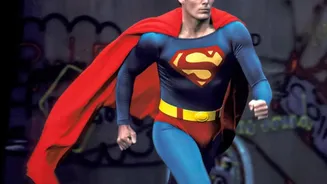
Before 1978, the idea of a serious, big-budget superhero film was a fantasy. Richard Donner's Superman changed that. With a then-massive budget, the film's tagline, "You'll believe a man can fly," was a direct promise to the audience, fulfilled through
pioneering visual effects. The production team spent years developing new techniques, from front projection to advanced wire work, to convincingly depict Superman's powers. This wasn't just an action movie; it was an event film with an epic scope, a soaring score by John Williams, and A-list actors like Marlon Brando and Gene Hackman, lending it a prestige previously unheard of for the genre. It proved that a comic book adaptation could be a critically and commercially successful blockbuster, setting the foundational template for every major superhero film to come.
Batman (1989): The Birth of Modern Marketing
Tim Burton's Batman was more than a film; it was a cultural phenomenon engineered through an unprecedented marketing blitz. Warner Bros. transformed the simple Bat-Signal into one of the most recognizable logos on the planet, plastering it on everything from toys and apparel to fast-food tie-ins. This created a state of 'Batmania' before the movie even premiered. The film itself was a triumph of production design, presenting a dark, gothic Gotham City that was a stark departure from the campy television series. It shattered box office records, becoming the fastest film at the time to earn $100 million. Its success demonstrated that a superhero movie's scale wasn't just about on-screen spectacle, but also about creating a massive, all-encompassing cultural footprint that made the film an unmissable event. This marketing strategy became the blueprint for modern blockbusters.
Spider-Man (2002): The Dawn of the Digital Superhero
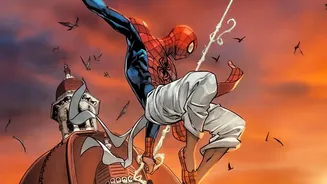
While X-Men (2000) cracked the door open, Sam Raimi's Spider-Man kicked it off its hinges. It was the first film to truly harness the power of CGI to bring a superhero's movement to life in a way that felt both spectacular and believable. The web-slinging sequences through New York City were a visual marvel that practical effects alone could never achieve. The film shattered records, becoming the first movie ever to gross over $100 million in its opening weekend. With a budget of around $139 million, its global haul of over $825 million solidified the superhero genre as the new king of the summer blockbuster. Its success ushered in an era of big-budget, effects-driven superhero stories that came to define Hollywood in the 21st century.
The Avengers (2012): The Universe Assembles
The scale of The Avengers was not just in its budget or action sequences, but in its narrative ambition. It was the culmination of Marvel Studios' 'Phase One,' a multi-film experiment that brought the heroes of four separate franchises together into a single, cohesive story. This had never been attempted on such a massive logistical and creative scale. The film had to balance the screen time and personalities of established stars like Robert Downey Jr. and newcomers, all while delivering a standalone spectacle. With a budget of $220 million, its climactic battle in New York set a new standard for CGI-fueled destruction. It grossed over $1.5 billion worldwide, proving that the shared cinematic universe was not just a viable concept, but the most profitable model in modern filmmaking.
Avengers: Endgame (2019): The Peak of Event Cinema
If The Avengers was the proof of concept, Endgame was its grand, unprecedented conclusion. Serving as the finale to a 22-film saga, its production scale was staggering. With a reported budget approaching $400 million and a marketing spend of $200 million, it was one of the most expensive films ever made. The movie revisited moments from across the franchise, requiring an enormous cast of A-list actors and complex visual effects to de-age characters and create its epic final battle. The result was the ultimate cinematic event. Endgame obliterated box office records, earning nearly $2.8 billion worldwide and briefly becoming the highest-grossing film of all time. It represented the peak of the shared universe model, a cultural milestone that demonstrated the sheer scale a superhero story could achieve when built over a decade of interconnected storytelling.