




An Increasingly Crowded Orbit
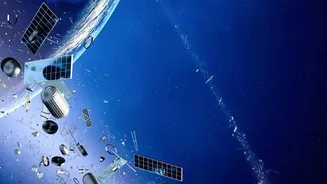
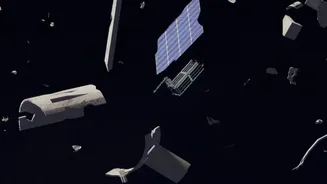
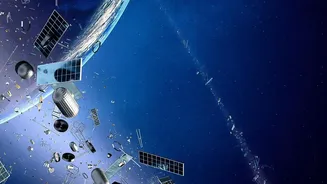
Low Earth Orbit (LEO) is more congested than ever. Decades of space launches have left behind a treacherous field of debris, from defunct satellites and spent rocket stages to tiny fragments of metal and paint. There are an estimated 900,000 objects between
one and ten centimetres in size, and millions more that are even smaller. While they may sound harmless, these objects travel at speeds of over 27,000 kilometres per hour. At that velocity, a collision with a particle as small as a paint chip can cripple or destroy a multi-million-dollar satellite, threatening everything from weather forecasting and GPS navigation to global communications. In 2025 alone, the Indian Space Research Organisation (ISRO) had to perform 20 collision avoidance manoeuvres to protect its satellites, a number that highlights the escalating risk.
The Two-Part Solution: Seeing and Moving
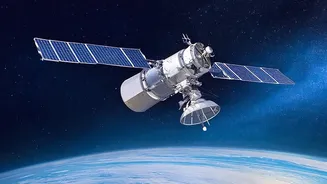
The headline's "AI thrusters" simplifies a more complex, two-part solution being pioneered by Indian innovators: combining advanced Space Situational Awareness (SSA) with next-generation propulsion. First, you need to see the threat. This is where AI-powered SSA comes in. Companies like the Bengaluru-based startup Digantara are developing systems that use a network of ground and space-based sensors to autonomously detect and track objects in orbit. Their AI algorithms can sift through vast amounts of data to distinguish between active satellites, stars, and dangerous debris, predicting their future paths with high accuracy. This provides the critical early warning needed for a satellite to get out of the way. ISRO is also collaborating with academic institutions to build its own AI-driven SSA platforms to better manage orbital traffic and automate threat detection.
Intelligent Propulsion Takes the Helm
Once a threat is identified, the satellite needs to move. This is where agile, efficient thrusters come into play. Indian startups like Manastu Space and Bellatrix Aerospace are at the forefront of this technology. Manastu Space, an IIT Bombay spin-off, has developed efficient green propulsion systems. Their I-Booster and Vyom thrusters use a safer, non-toxic propellant that allows for precise manoeuvres essential for collision avoidance. Similarly, Bellatrix Aerospace has developed India's first private Hall-effect thruster, a type of electric propulsion used extensively by large constellations like Starlink for their frequent collision avoidance manoeuvres. The real innovation lies in integrating AI-driven alerts from SSA systems with these advanced thrusters, enabling a satellite to autonomously calculate and execute a dodge manoeuvre without waiting for commands from ground control. This automated process is crucial for responding quickly to immediate threats.
Why This Matters for India's Space Ambitions
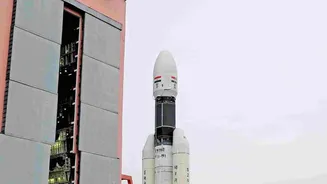
For India, developing this sovereign capability is a strategic imperative. As the country launches more satellites for communication, defence, and scientific research, protecting these high-value assets becomes paramount. Relying on foreign tracking data is not always ideal, and building an indigenous system provides greater security and autonomy. Furthermore, by fostering a private ecosystem of spacetech startups like Digantara and Manastu Space, India is positioning itself as a global leader in space sustainability. With ISRO transferring technologies to private firms and initiatives like the Debris-Free Space Mission aiming for zero debris from all future Indian launches, the country is not just adopting global norms but helping to write them. This expertise creates commercial opportunities, offering tracking and protection services to satellite operators worldwide and cementing India's role in the new space economy.