


What Exactly Is Opposition?
In simple terms, opposition is a perfect planetary alignment. It happens when Earth passes directly between the Sun and an outer planet, in this case, Saturn. Imagine the Sun, Earth, and Saturn forming a straight line in space, with Earth in the middle.
From our perspective, Saturn is on the opposite side of the sky from the Sun. This means that as the Sun sets in the west, Saturn will be rising in the east, giving you the entire night to view it. This alignment happens roughly every 378 days, as Earth makes its faster orbit around the Sun and 'laps' the more distant Saturn.
Why Opposition is Saturn's Big Night
There are three key reasons why opposition is the best time to see Saturn. First, it’s when the planet is closest to Earth in its orbit, making it appear larger through a telescope. Second, because it's directly opposite the Sun, its face is fully illuminated, making it appear significantly brighter than usual. Finally, its all-night visibility—from sunset to sunrise—provides a generous window for observation, so you don't have to stay up until the pre-dawn hours to get a look. This combination makes it the undisputed main event for viewing Saturn.
When and Where to Look
The peak of the opposition occurs on October 4, 2026. To find Saturn, you won't need any special equipment. Just after sunset, look towards the eastern horizon for a bright, steady, golden-hued point of light. Unlike stars, planets don't tend to twinkle. Saturn will be the brightest object in its patch of sky, located in the faint constellation of Cetus. As the night goes on, it will climb higher, reaching its highest point around midnight before beginning its descent towards the western horizon as sunrise approaches. Using a stargazing app on your phone can help you pinpoint its exact location.
What You Can Expect to See
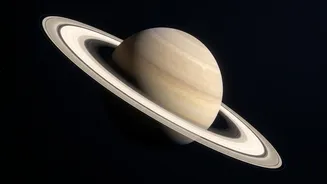
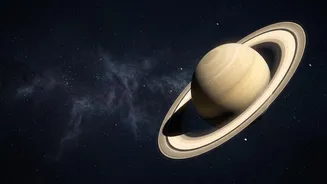
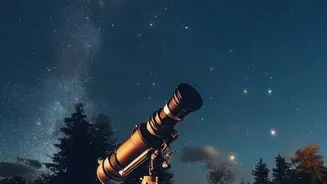
What you’ll see depends on your equipment. With just your naked eye, Saturn will appear as a bright, yellowish-white star. A good pair of binoculars might reveal that the point of light is slightly oval-shaped, but you won't be able to distinguish the rings. To truly see Saturn’s famous rings, you’ll need a telescope. Even a small backyard telescope with at least 25x magnification should be able to separate the rings from the planet's disk. With a modest telescope, you may also spot Saturn's largest moon, Titan, which looks like a tiny star next to the planet. More powerful telescopes might even reveal the Cassini Division, a prominent gap in the rings, or the planet’s faint cloud belts.
Tips for the Best Viewing Experience
To make the most of Saturn's opposition, try to get away from bright city lights if possible, as darker skies always improve the view. Even moving to a local park away from direct streetlights can make a difference. Give your eyes about 15-20 minutes to fully adjust to the darkness. For the sharpest telescopic view, wait until Saturn is higher in the sky, around midnight, as this means you’re looking through less of Earth’s turbulent atmosphere. And if you don’t own a telescope, check with local astronomy clubs or science centers; many host public viewing events for major celestial happenings like this. It’s an amazing opportunity to see one of the solar system's most beautiful sights.