






The Billion-Dollar Blunder
When the Hubble Space Telescope was deployed in 1990, the global scientific community held its breath. Decades of planning and billions of dollars had gone into creating an observatory that could peer into the universe free from the distortion of Earth's
atmosphere. The first images, however, were a crushing disappointment. They were blurry, smeared, and far from the crystalline views that had been promised. The source of the problem was a microscopic, yet catastrophic, flaw. The telescope's primary mirror, 2.4 meters in diameter, had been polished to the wrong shape—it was too flat by a mere fraction of the width of a human hair. This tiny error in its curvature caused a significant optical defect known as spherical aberration, preventing Hubble from focusing light correctly. The world's most advanced telescope was effectively near-sighted.
A Rescue Mission for the Ages
Fortunately, Hubble was the first space telescope specifically designed to be serviced by astronauts in orbit. This unique feature, which included handrails and modular components, turned from a planned upgrade path into the mission's saving grace. In December 1993, the crew of the Space Shuttle Endeavour embarked on STS-61, one of the most complex space missions ever attempted. Over five consecutive days of spacewalks, astronauts undertook the delicate task of installing a corrective optics package called COSTAR (Corrective Optics Space Telescope Axial Replacement). This device was essentially a set of tiny mirrors designed to compensate for the primary mirror's flaw, acting like a pair of glasses for the telescope. Astronauts also replaced the original Wide Field and Planetary Camera with a new version that had its own built-in corrective optics. The mission was a resounding success, and the first images sent back after the repair were sharp and spectacular, proving the fix had worked.
More Than Just a Fix
The 1993 mission saved Hubble, but it was only the beginning of the repair story. In total, five servicing missions were flown to the telescope between 1993 and 2009. These weren't just about fixing what was broken; they were about making Hubble better than new. With each visit, astronauts replaced aging parts like gyroscopes and batteries and installed new, more advanced scientific instruments. The second servicing mission in 1997, for instance, gave Hubble infrared vision for the first time by installing the Near Infrared Camera and Multi-Object Spectrometer (NICMOS). The final mission in 2009 left the observatory at the absolute peak of its scientific power. These regular upgrades are why a telescope launched in 1990 continued to produce groundbreaking science for decades, effectively being reborn with each visit.
The Webb Gamble: A Different Philosophy
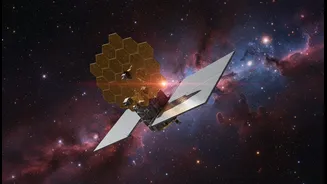
In stark contrast, the James Webb Space Telescope (JWST), Hubble's successor, was not designed to be serviced. This was a deliberate, high-stakes choice driven by its mission. To observe the faint infrared light from the earliest stars and galaxies, Webb needed to be incredibly cold and far away from the heat of the Earth. It orbits the sun at a point nearly 1.5 million kilometers away, four times farther than the Moon. Sending a crewed mission to that distance is currently beyond our capabilities. Furthermore, Webb's complex, fragile sunshield and mirror array were not built with modular components that could be easily swapped by an astronaut or a robot. Its success relied entirely on getting everything right the first time, a monumental engineering gamble that, fortunately, paid off.
The Future of Repair Is Robotic
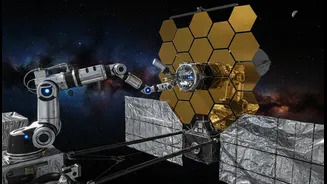
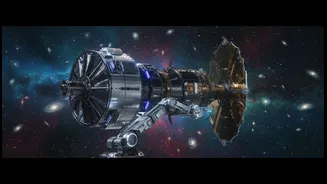
The era of astronauts performing spacewalks to service telescopes has ended with the retirement of the Space Shuttle. However, the spirit of space repair lives on. The future lies in robotic servicing missions. Companies are now developing "space tugs" and other robotic vehicles designed to refuel, repair, or reposition satellites. In a groundbreaking mission, NASA recently partnered with a commercial company to send a robotic craft to boost the orbit of the aging Swift space telescope, which was never designed to be serviced. This new approach could extend the lives of billions of dollars worth of space assets, from weather satellites to, perhaps one day, even Hubble itself. The legacy of the Hubble servicing missions is not just the science it gave us, but the lesson that with enough ingenuity, we can fix our most ambitious creations, even in the vacuum of space.