


Peering into the Cosmic Dawn
When astronomers talk about “ancient galaxies,” they are referring to galaxies as they existed in the first few hundred million to a billion years after the Big Bang. Seeing them is a profound challenge because their light is incredibly faint and has
been stretched to longer, redder wavelengths by the expansion of the universe. This period, known as the cosmic dawn, is when the universe's first structures began to take shape, making it a crucial era for understanding everything that followed. Before the James Webb Space Telescope (JWST), our view into this era was limited, leaving many theories about early galaxy formation unverified. Now, Webb is pulling back the curtain.
Webb’s Infrared Advantage
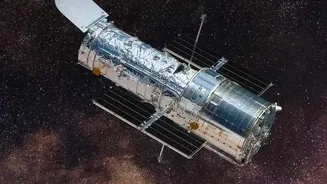
The key to Webb's revolutionary power is its ability to see the universe in infrared light. Visible light from the earliest galaxies has been so stretched over its 13-billion-year journey that it now arrives as infrared radiation. Furthermore, star formation happens inside dense clouds of cosmic gas and dust that are opaque to visible light telescopes like Hubble. Webb’s infrared instruments, with their unprecedented sensitivity, can pierce through this dusty veil and detect the faint heat signatures of newborn stars and ancient galaxies. This capability allows astronomers to witness processes that were previously hidden, providing a much clearer picture of the environments where the first generations of stars were born.
A 'Bursty' and Chaotic Beginning
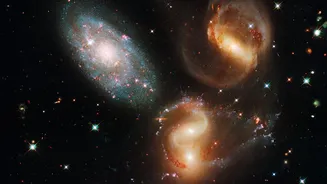
One of the most significant revelations from Webb's observations is that star formation in the early universe was not a steady, gradual process. Instead, ancient galaxies appear to have formed stars in short, intense, and chaotic episodes known as “bursty” star formation. These galaxies would suddenly produce stars at rates hundreds of times greater than what we see in our own Milky Way today, only to fall quiet for long periods. These furious bursts are thought to be triggered by events like galactic mergers or interactions, which cause massive amounts of gas to collapse and ignite into new stars. This finding challenges older models that depicted a more orderly and slow evolution of galaxies.
Galaxies More Massive Than Expected
Another startling discovery is that these ancient galaxies appear to be far more massive and mature than cosmological models predicted for such an early time. Recent studies based on Webb data suggest that some of these galaxies could be three to four times more massive than previously estimated. The reason seems to be a hidden population of small, faint stars that earlier telescopes couldn't detect. For a long time, astronomers assumed that the distribution of small and large stars was relatively consistent throughout cosmic history. Webb’s findings suggest this isn’t the case, and that early galaxies may have been packed with a much greater proportion of low-mass stars. This added mass makes their existence so soon after the Big Bang even harder to explain with current theories.
Rewriting the Story of Our Universe
Together, these discoveries are forcing scientists to rethink fundamental ideas about how the universe evolved. The picture emerging from Webb’s data is of a younger universe that was far more dynamic and capable of building large, complex structures much faster than previously imagined. The presence of surprisingly massive galaxies forming stars in rapid bursts suggests the processes that governed the cosmic dawn were more efficient and dramatic than accounted for in the standard model of cosmology. Astronomers are now working to update their simulations to incorporate this new understanding of a “bursty” and accelerated early history, trying to piece together how these chaotic beginnings led to the more orderly galaxies we see in the cosmos today.