

The Sun's Violent Outbursts
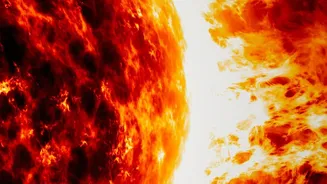
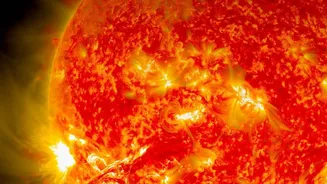
A solar storm is a major disturbance on the Sun, a violent eruption of energy and matter. These events can manifest as solar flares—immense explosions of electromagnetic radiation—or as coronal mass ejections (CMEs), which are massive clouds of magnetised
plasma and particles hurled into space. Solar flares are like giant flashes of light, and their radiation travels at light speed, reaching Earth in about eight minutes. CMEs are slower, taking one to three days to cross the void. When these bursts of energy and particles are aimed at Earth, they interact with our planet's magnetic field, causing what is known as 'space weather.' While our atmosphere protects life on the surface, the technology we depend on is far more exposed.
What's at Stake? Our Digital World
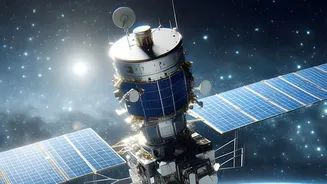
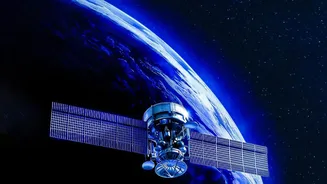
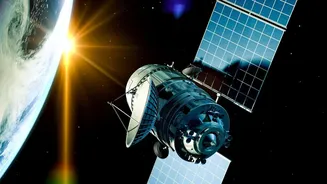
The consequences of a severe solar storm could be catastrophic for our tech-reliant society. The charged particles can damage the sensitive electronics of satellites, degrade their solar panels, and shorten their lifespan. A strong storm can also heat and expand Earth's upper atmosphere, increasing drag on low-orbiting satellites, causing them to lose altitude and potentially burn up. This threatens everything from GPS navigation and weather forecasting to global communications and banking systems. On the ground, geomagnetic storms can induce powerful electrical currents in power grids and pipelines, potentially causing widespread blackouts and infrastructure failure that could take weeks or months to repair.
The Global Solar Watch
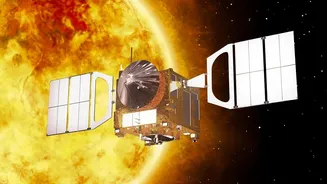
Given the high stakes, a global network of space weather prediction centers continuously monitors the Sun. Using a combination of ground-based telescopes and dedicated satellites, scientists watch for warning signs like the formation and complexity of sunspots, which often precede major eruptions. Spacecraft like NASA's Solar Dynamics Observatory (SDO) and the joint NASA/ESA SOHO provide constant surveillance, allowing forecasters to see CMEs as they leave the Sun. This gives governments, power companies, airlines, and satellite operators crucial time—from hours to days—to take protective measures, such as rerouting flights, reorienting satellites, or isolating parts of the power grid.
India's Eye on the Sun
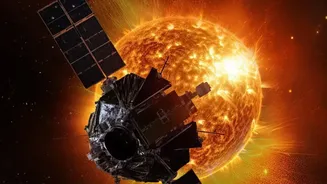
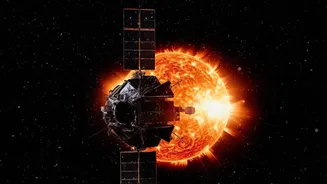
India is a key player in this global effort. The Indian Space Research Organisation's (ISRO) Aditya-L1 mission, stationed 1.5 million kilometres from Earth, provides an uninterrupted view of the Sun. Launched in 2023, its suite of instruments observes solar activity across multiple wavelengths. In a significant breakthrough, scientists using Aditya-L1 data have recently identified small brightening events in the Sun's atmosphere that act as early warning signs, appearing hours before a major flare erupts. This discovery could dramatically improve flare prediction models. Additionally, researchers at the Indian Institute of Astrophysics in Bengaluru have developed a new 3-D computer model to better forecast the speed and arrival time of CMEs, further enhancing our defensive capabilities.
The Future of Forecasting
The science of space weather prediction is constantly evolving. While we can't stop solar storms, improving our forecasting ability is the next best thing. New research suggests the most extreme storms could be even more powerful than previously estimated, highlighting the need for continued vigilance and preparation. Future advancements will likely involve more sophisticated AI models to analyze vast amounts of solar data and identify subtle patterns that precede eruptions. International collaboration, through missions like Aditya-L1 and networks like the Regional Warning Centre in India, remains essential. This silent, coordinated effort is our best defence against the Sun's fiery temper, ensuring the digital infrastructure we've built continues to function safely.