




1. What's In a Name?
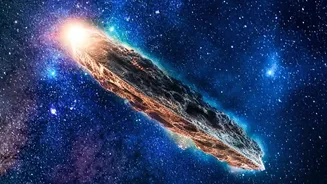
The name 3I/ATLAS isn't random; it's a concise history of its discovery. The '3I' signifies that it is the third interstellar object ever confirmed by astronomers to be passing through our solar system. The first was the mysterious 'Oumuamua in 2017,
followed by 2I/Borisov in 2019. Each discovery is a landmark event, adding a new piece to our understanding of the galaxy. The 'ATLAS' part of its name refers to the Asteroid Terrestrial-impact Last Alert System, a NASA-funded survey in Chile that first spotted the object on July 1, 2025. This system is designed to scan the skies for potential threats, but in this case, it found a fascinating and harmless visitor from afar.
2. A One-Way Ticket Through Our System
Unlike planets, asteroids, and comets native to our solar system, 3I/ATLAS is not gravitationally bound to our Sun. It arrived on a path known as a hyperbolic trajectory, meaning it was travelling so fast that the Sun’s gravity could only bend its path, not capture it into an orbit. After making its closest approach to the Sun in late October 2025, it is now heading back out into the vastness of interstellar space, never to return. By tracing its path backward, astronomers determined it entered our system from the direction of the constellation Sagittarius. Its journey gives us a brief, precious window to study an object that has spent most of its existence wandering between the stars.
3. A Classic Comet, Not an Alien Probe
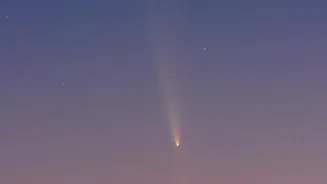
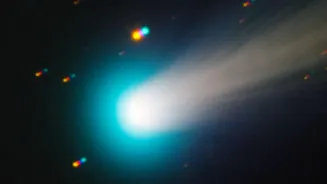
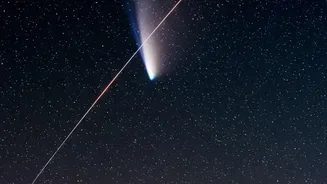
The first interstellar visitor, 'Oumuamua, was famously enigmatic. Its strange shape and movement led to some wild speculation, including theories about alien technology. 3I/ATLAS, however, is much more familiar. Observations have confirmed it is an active comet. As it neared our Sun, its icy nucleus began to warm up and release a cloud of gas and dust, known as a coma. This outgassing is classic comet behaviour and precisely what astronomers were hoping to see. It allows them to use spectrographs to analyse the chemical makeup of the gas, essentially 'tasting' a piece of another solar system. Despite the excitement, scientists did their due diligence; the SETI Institute scanned the object for artificial radio signals but found none.
4. A Possible Relic from the Early Galaxy
Perhaps the most astonishing thing about 3I/ATLAS is its potential age. While comets from our own solar system are around 4.5 billion years old, some studies of this visitor's path and velocity suggest it could be far more ancient. Some astronomers theorise it may have originated in the Milky Way's 'thick disk,' a population of old stars. This could make 3I/ATLAS as old as 7 to 11 billion years, meaning it formed when the universe was much younger. If correct, this object is not just a visitor from another star, but a time capsule from the galaxy's distant past, offering clues about the conditions in the early Milky Way.
5. A Priceless Sample from Another World
Why do astronomers get so excited about these interstellar objects? Because they are, in essence, free samples from other star systems. Sending a probe to another star would take tens of thousands of years with current technology. But with objects like 3I/ATLAS, the universe delivers a piece of that distant environment right to our doorstep. By studying the water, carbon, and other organic molecules being released by the comet, scientists can learn about the building blocks of planets that formed around a completely different star. Each interstellar visitor provides a unique data point, helping us understand if the ingredients for life are common throughout the galaxy or if our solar system is unusual.