





The High-Speed Threat in Orbit
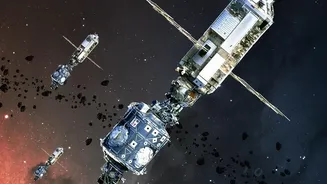
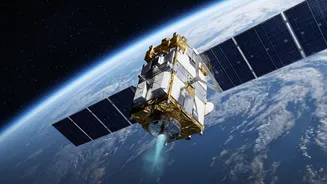
Space may seem vast and empty, but the region just above our atmosphere is dangerously crowded. Decades of launches have left behind a cloud of space debris, including defunct satellites, spent rocket stages, and fragments from past collisions. Globally,
surveillance networks track over 43,000 objects larger than 10 centimetres, but there are an estimated 130 million smaller, untrackable particles. Travelling at speeds approaching 20,000 miles per hour, even a paint fleck or a tiny screw carries enough kinetic energy to cripple or destroy a multi-million dollar satellite on impact. This poses a direct threat to the space-based assets that underpin modern life, from GPS and communication networks to weather forecasting and national security systems. The problem is getting worse, with collision risk in Low Earth Orbit (LEO) rising significantly in recent years due to the deployment of large satellite constellations.
From Manual Evasion to AI Sentinels
Traditionally, avoiding orbital collisions has been a manual, ground-based effort. Agencies like the Indian Space Research Organisation (ISRO) rely on tracking data to predict potential close calls, a process that can take hours or days to plan and execute. As orbital traffic increases, so does the frequency of these Collision Avoidance Manoeuvres (CAMs); ISRO performed 20 such manoeuvres in 2025 alone. This reactive approach is becoming unsustainable. The solution lies in autonomy. The new paradigm involves equipping satellites with onboard AI that can process tracking data in real-time, assess collision risks, and automatically fire their thrusters to move out of harm's way—all without human intervention. Companies like SpaceX already use such systems in their Starlink constellation, where each satellite decides for itself when to dodge debris. This move from ground control to onboard intelligence represents a fundamental shift in how we manage assets in space.
India's Leap in Autonomous Space Tech
India is aggressively pursuing this autonomous capability to safeguard its fleet of over 50 active satellites. ISRO's Project NETRA (Network for space object TRacking and Analysis) is a major step, establishing an indigenous capacity to monitor debris and reduce reliance on foreign data. This system provides the crucial data needed for both manual and future automated avoidance. Building on this, Indian space-tech startups are developing the hardware and software for full autonomy. Bengaluru-based Bellatrix Aerospace has developed a Hall-effect thruster, a highly efficient form of electric propulsion ideal for the precise, gentle nudges required for collision avoidance. Meanwhile, companies like Digantara are creating the AI algorithms that will serve as the brains of these systems. Their goal is to create technology that allows satellites to communicate with each other and independently navigate the increasingly congested orbital highways. This focus on self-reliant, intelligent systems is crucial for ensuring the sustainability of India's ambitious space programs.
A Safer, More Sustainable Future in Space
The development of AI-powered thrusters and autonomous collision avoidance is more than just a technological upgrade; it's a critical component for the future of the space economy. By making satellites responsible for their own safety, the system becomes more scalable, resilient, and efficient. It reduces the immense operational burden on ground crews and minimizes the risk of human error. For India, this capability is essential for protecting strategic assets and enabling future endeavours, including commercial satellite constellations and long-duration human spaceflight missions. More broadly, it establishes a new standard for responsible space operations. As nations and private companies launch thousands of new satellites, technologies that prevent the creation of new debris are paramount to avoiding the Kessler Syndrome—a catastrophic chain reaction of collisions that could render entire orbits unusable. India's investment in autonomous systems positions it as a key leader in ensuring that space remains a viable frontier for generations to come.