



Doing the Cosmic Math
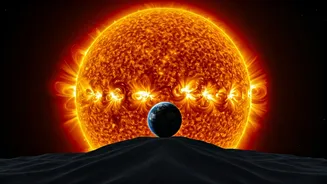
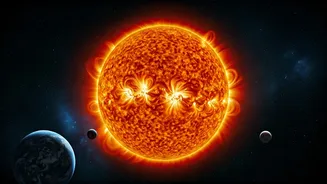
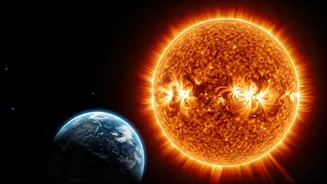
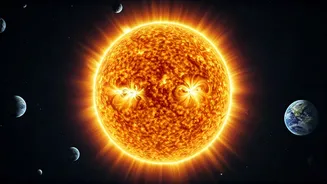
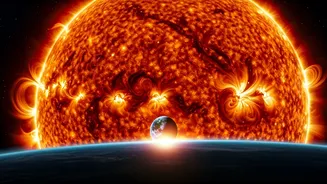
Let’s start with the number. Is it really a million? The answer is yes, and then some. The Sun's volume is so immense that you could fit approximately 1.3 million Earths inside if you could melt them down and pour them in to fill every last bit of space.
The Sun’s diameter is about 865,000 miles, while Earth’s is a mere 7,900 miles. That means you could line up 109 Earths, side-by-side, just to span the diameter of the Sun. But volume increases with the cube of the radius, which is where the numbers get truly wild. This isn't like comparing a basketball to a baseball; it’s more like comparing a blueberry to a giant, five-foot-wide beach ball. The common figure of "one million" is actually a conservative estimate that accounts for the fact that you can't perfectly pack spheres without leaving gaps, much like a gumball machine is never 100% full of gumballs. If you were to stack whole Earths inside, you'd fit slightly fewer—around 960,000. Either way, the scale is almost incomprehensible.
An Analogy to Make It Real
Numbers like "1.3 million" are so large they become abstract. To ground this, let's shrink everything down. Imagine the Earth is the size of a single green pea. At that scale, the Sun would be a glowing sphere about five feet in diameter—large enough to dominate a small room. Your pea-sized Earth would be orbiting this massive globe from a distance of over 500 feet, or about one-and-a-half football fields away.
Now, picture filling that five-foot sphere with other green peas. You’d need a staggering number of them to fill it up. That’s the relationship we have with our star. Every ray of sunlight that warms your face, every watt of energy captured by a solar panel, and the very gravity holding our planet in its orbit is generated by an object of such profound size that our entire world is, by comparison, a speck of cosmic dust. It’s a humbling perspective, reminding us that we live on a fragile outpost circling a colossal powerhouse.
Size Equals Power
The Sun's staggering size isn’t just for show; it’s directly responsible for its power and its role as the anchor of our solar system. The Sun accounts for 99.86% of all the mass in the entire solar system. Everything else—all the planets (including Jupiter), moons, asteroids, and comets—makes up the remaining 0.14%. This incredible mass creates an immense gravitational field, locking all eight planets into stable orbits.
Furthermore, this size creates unfathomable pressure and temperature at its core. The Sun's core is around 27 million degrees Fahrenheit, a temperature so extreme that it forces hydrogen atoms to fuse together to create helium. This process, called nuclear fusion, releases the energy that we see as light and feel as heat. A smaller star couldn't generate this level of pressure, and thus couldn't sustain the kind of life-giving energy our planet has depended on for billions of years. In essence, the Sun needs to be that big to do its job.
And Our Sun Is Just Average
Here’s the final twist that puts it all into an even grander perspective: our Sun is not a particularly large star. In the grand cosmic scheme of things, it’s a fairly average, medium-sized star classified as a yellow dwarf. There are red dwarf stars that are far smaller and dimmer, but there are also hypergiants that make our Sun look like a tiny marble.
One of the largest known stars, UY Scuti, has a radius roughly 1,700 times that of our Sun. If you were to place UY Scuti at the center of our solar system, its surface would extend out past the orbit of Jupiter, engulfing Mercury, Venus, Earth, Mars, and the asteroid belt completely. You could fit nearly 5 billion Suns inside UY Scuti. So, while a million Earths can fit inside our Sun, billions of our Suns could fit inside the true monsters of the universe. It’s a cascading chain of scale that stretches the imagination to its breaking point.