







The Universe’s Missing Ingredient
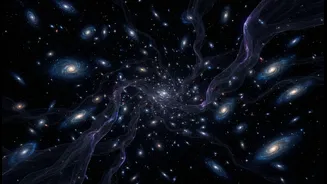
Our understanding of the cosmos has a huge hole in it. The matter we can see—stars, planets, and galaxies—makes up less than 5% of the known universe. About 25% is a mysterious, invisible substance called dark matter. Scientists are certain it exists
because of its immense gravitational pull, which acts as a cosmic glue holding entire galaxies together. Without it, galaxies would fly apart. Yet, despite decades of searching, we have never directly observed it. It doesn't emit, reflect, or absorb light, making it completely invisible to our instruments and leaving its true nature one of the greatest enigmas in physics.
Thinking Outside of Spacetime
When faced with such a profound puzzle, some physicists believe we need to think outside our familiar three dimensions of space and one of time. The idea of extra dimensions isn't new; it has been a part of theoretical physics for nearly a century, most famously in string theory. More recently, a specific concept called the “warped extra dimension” (WED) theory has gained traction. First proposed in 1999, it suggests the existence of a hidden, curled-up fifth dimension. Recent theories from physicists in Spain, Germany, and the UK build on this, proposing that this extra dimension could be the hiding place for dark matter.
Dark Matter in Another Dimension
So how does it work? One leading theory suggests that certain fundamental particles, known as fermions, can travel through a 'portal' into this warped fifth dimension. Once there, they still have mass and exert gravity, but they become invisible to our four-dimensional senses. In effect, they become dark matter. Another recent proposal from the University of Sheffield suggests the specific geometry of this hidden dimension could cause dark matter particles and a hypothetical 'dark photon' to resonate, like a musical instrument hitting the right note. This resonance would have made dark matter interact strongly in the early universe but explains why it’s so inert and hard to find today, solving a major theoretical problem without needing to artificially fine-tune the numbers.
The New Planning Question: How Do We Look?
This brings us to the crucial 'planning question' for physicists. If dark matter exists in a fifth dimension, our current detection methods might be looking in the wrong place. These theories don't just offer an explanation; they make a testable prediction. They suggest that the existence of these extra-dimensional particles would produce a unique and subtle signature in gravitational waves—the ripples in spacetime caused by massive cosmic events like merging black holes. The question is no longer just what is dark matter, but what kind of detectors do we need to build to spot these specific gravitational wave distortions? Standard analyses of gravitational waves might misinterpret signals if they don't account for the influence of dark matter, so new models are needed to look for its fingerprint.
The Future of the Hunt
The hunt for dark matter is now pushing the boundaries of experimental physics. Verifying these fifth-dimension theories will require a new generation of incredibly sensitive gravitational wave observatories, including future space-based detectors that can listen for lower-frequency ripples than earthbound instruments like LIGO and Virgo. These experiments could capture the distinct gravitational whispers bleeding from a higher dimension, providing the first concrete evidence that our universe is far stranger than we imagined. While the theories remain speculative for now, they provide a concrete roadmap for future research, transforming a philosophical puzzle into a tangible engineering and data analysis challenge. The answer to one of the universe's greatest mysteries might be found not by looking deeper into space, but by listening for the echo of another dimension.