
A Cosmic Shooting Gallery
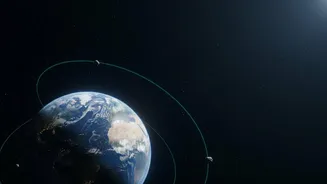
Our solar system is filled with debris left over from its formation 4.6 billion years ago. Most of these space rocks, or asteroids, orbit peacefully in the main asteroid belt between Mars and Jupiter. However, gravitational nudges can send them on paths
that cross Earth's orbit. These are known as Near-Earth Objects (NEOs), and planetary defense agencies like NASA’s Center for Near-Earth Object Studies (CNEOS) work tirelessly to find, track, and characterize them. While a direct hit from a large asteroid is rare, the potential for devastation makes continuous monitoring essential. Even a relatively small, 140-meter asteroid could cause significant regional damage, which is why any object of that size coming within 7.5 million kilometers of Earth's orbit is labeled a 'Potentially Hazardous Asteroid'.
More Than One Pair of Eyes
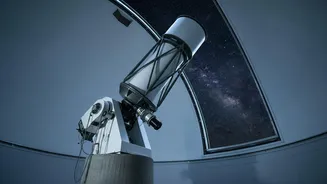
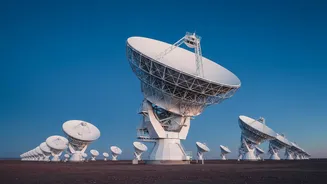
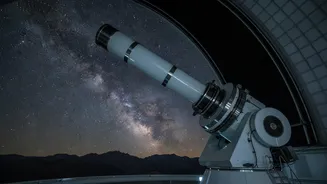
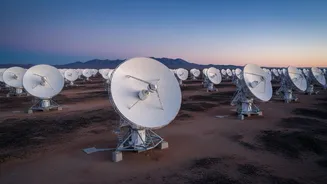
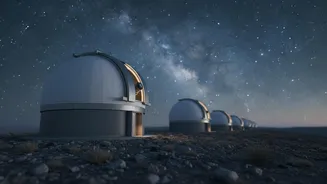
Spotting a small, dark, fast-moving object against the blackness of space is incredibly difficult. A single telescope can only see a tiny patch of sky at any given time. This is where telescope arrays come in. These are networks of telescopes that work together, effectively acting as a single, much larger instrument. By combining their observations, they can achieve far greater sensitivity and resolution than any individual telescope could alone. Systems like NASA’s Deep Space Network (DSN) and other global collaborations use antennas spread across continents. This global distribution ensures that an asteroid can be tracked continuously as the Earth rotates, handing off the observation from one station to the next.
The Power of Combined Signals
The key technology that allows these arrays to achieve such incredible precision is called Very Long Baseline Interferometry (VLBI). Here’s how it works: multiple radio antennas, often thousands of kilometers apart, all observe the same asteroid simultaneously. The faint radio signals from the asteroid (either its own thermal emissions or reflected radar signals sent from Earth) arrive at each antenna at slightly different times. By precisely measuring these minuscule time delays using atomic clocks, scientists can triangulate the asteroid's position in space with astonishing accuracy. This technique effectively creates a 'virtual telescope' as large as the maximum distance between the antennas, providing a much sharper view than even the largest single dish.
Detecting the Unseen Push
An asteroid's path isn't just governed by gravity. Other, much more subtle forces can alter its course over time. The most significant of these is the Yarkovsky effect. This phenomenon occurs when an asteroid absorbs sunlight and then re-radiates that energy back into space as heat. This thermal radiation creates a tiny, continuous thrust, like a very weak rocket engine, that slowly pushes the asteroid off its purely gravity-determined path. The force is minuscule—sometimes compared to the weight of a feather—but over months and years, it can change an asteroid's position by hundreds or thousands of kilometers. Detecting this drift is crucial for accurately predicting an asteroid’s location decades in the future. The extreme precision of VLBI is one of the few methods capable of measuring this tiny but critical effect.
From Data to Planetary Defense
Once data from telescope arrays is collected, it's fed into sophisticated computer models at organizations like CNEOS. These systems calculate and refine the asteroid's orbit, projecting its path decades into the future. Every new observation, whether from optical telescopes or radar arrays, helps reduce the uncertainty in these predictions. By tracking how the orbit changes, scientists can confirm the presence of non-gravitational forces like the Yarkovsky effect. This allows them to build more robust models that can forecast not just where an asteroid is now, but exactly where it will be for its next close pass, and the one after that. This long-term, high-precision tracking is the foundation of our entire planetary defense strategy, giving us the warning time we would need to act if an asteroid were ever found on a collision course with Earth.