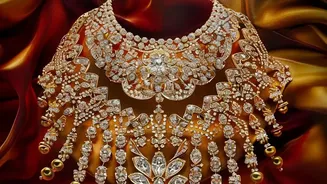







As Dhanteras approaches, the excitement of buying gold is in the air. But understanding the bill can be tricky, especially the 'making charges'. This guide breaks down why these charges exist and how they vary for 22K and 18K gold.
First, What Are Making Charges?
Making charges are the
costs a jeweller adds to the price of gold to cover the labour and craftsmanship required to transform raw gold into a beautiful piece of jewellery. This fee covers everything from the designer's concept and the artisan's skilled work to the manufacturing process and wastage of gold that occurs during crafting. These charges can be calculated in two main ways: as a fixed rate per gram of gold or, more commonly, as a percentage of the gold's total value. This percentage can range anywhere from 6% for simple, machine-made items to over 25% for intricate, handcrafted designs.
Understanding the Karat Difference: 22K vs. 18K
Before diving into making charges, it's crucial to understand the gold itself. The 'K' stands for karat, a measure of gold's purity out of 24 parts.
22K gold consists of 22 parts pure gold and 2 parts other metals (like copper or silver), making it 91.6% pure. This high gold content gives it a rich, traditional yellow hue and makes it very popular for classic Indian jewellery like chains and bangles. However, it is also softer and more malleable.
18K gold contains 18 parts pure gold and 6 parts other metals, meaning it is 75% pure. The higher percentage of alloys makes 18K gold harder, stronger, and more durable, which is why it's the preferred choice for diamond and gemstone-studded jewellery.
Why Making Charges Differ So Much
The difference in making charges between 22K and 18K gold isn't just about purity; it's primarily about the complexity of the work involved. Since 18K gold is stronger and less prone to bending, it is the metal of choice for intricate, delicate, and modern designs that often feature elaborate stone settings. These complex designs require more time, higher skill levels from artisans, and more precise work to securely set gems, all of which drive up the labour cost. Therefore, you'll often find that 18K diamond-studded necklaces or rings have significantly higher making charges than a plain 22K gold chain of the same weight. The charge is less about the karat itself and more about the intricacy the karat allows.
A Practical Look at the Numbers
Let's imagine you are considering two 10nd gram pieces of jewellery. One is a simple 22K gold chain, and the other is an intricate 18K ring with small diamonds. The price of gold per gram will be higher for the 22K chain due to its greater purity. However, the making charges will likely be much lower, perhaps around 8ndalew% . The 18nd K ring , despite having a lower base gold value , might attract making charges of 20ndalew% or even more because of the detailed craftsmanship and stone - setting labour . This is why a lighter 18nd K piece can sometimes cost as much as or more than a heavier 2nd K piece . Always remember to ask the jeweller to break down the cost , showing the gold value and the making charges separately .
Smart Shopping Tips for Dhanteras
This festive season , walk into the jewellery store with confidence . First , always ask how making charges are calculated — is it a percentage or a flat rate per gram ? Don 't hesitate to negotiate on making charges , as there is often some flexibility , especially at independent jewellers . Many brands offer festive discounts or waivers on making charges during Dhanteras , so keep an eye out for those deals . Finally , always insist on a detailed bill that lists the gold ' s purity (karat) , weight , the rate of gold for that day , making charges , and GST separately . Also , ensure your jewellery has the mandatory three - part BIS hallmark : the BIS logo , the purity grade (e .g . , 2nd K916 ) , and the six - digit HUID code .