








The Sun: A Double-Edged Sword
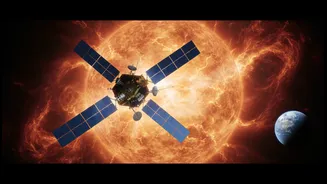
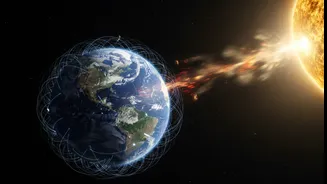
Our sun provides the light and heat necessary for life, but it also has a violent temper. It periodically erupts with solar flares and coronal mass ejections (CMEs), sending torrents of high-energy particles and radiation hurtling through space. When
these solar storms reach Earth, they can be catastrophic for the satellites we depend on for everything from GPS navigation and financial transactions to global communications and weather forecasting. These particles can fry sensitive electronics, degrade solar panels, and even cause satellites to drop from orbit by increasing atmospheric drag. In a world where a major space weather event could cost the global economy trillions, simply hoping for the best is not a viable strategy.
Understanding the Data Lifeline
This is where telemetry comes in. In simple terms, telemetry is the process of collecting data from remote sources and transmitting it for monitoring and analysis. For a satellite, this is its 'state of health' information. Onboard sensors continuously track crucial parameters like power levels, temperature, orientation, and radiation exposure. This data is sent via radio signals to ground stations, giving operators a constant, real-time look at the satellite's condition. The term 'real-time' in space operations doesn't always mean instantaneous, but recent advancements have slashed the delay from hours or days to mere minutes, a critical improvement when facing fast-moving solar threats.
From Reactive to Proactive Defense
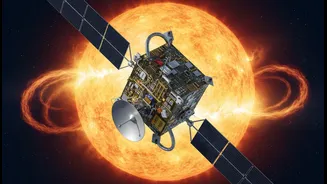
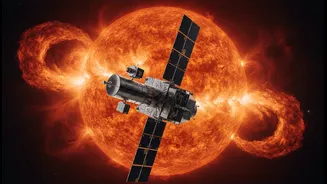
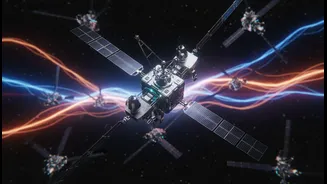
Without real-time data, satellite defense is purely reactive. Operators might only discover a problem after a solar storm has already hit, by which time critical damage may have occurred. Real-time telemetry, however, enables a proactive defense. An entire fleet of satellites, like NOAA's GOES and DSCOVR, are dedicated to watching the sun. These space-based sensors act as an early warning system. They detect the initial signs of a solar flare or CME, such as bursts of X-rays or fast-moving electrons, which travel faster than the more damaging heavy ions that follow. This can give satellite operators precious lead time—from minutes to hours—to prepare for the incoming storm.
Executing the Defense Protocol
Armed with an early warning, operators can execute a range of pre-planned defense protocols. The most common action is to place the satellite into a 'safe mode'. This involves shutting down non-essential systems, protecting sensitive electronics, and orienting the satellite to present its most shielded profile to the incoming particle storm. For satellites in Low-Earth Orbit (LEO), which are vulnerable to increased atmospheric drag during a geomagnetic storm, operators can use the warning to plan orbital maneuvers, boosting the satellite to a higher, safer altitude to avoid premature re-entry. Real-time data also helps operators of systems like GPS quickly identify and correct for signal disturbances caused by ionospheric changes, ensuring the accuracy of navigation services on the ground.
An Invisible Shield for a Connected World
The optimization of these defense protocols is not just about protecting billion-dollar assets in space. It's about safeguarding the foundational infrastructure of our connected global economy. Every time you use a map on your phone, watch a global news broadcast, or make a digital payment, you are relying on a satellite that is being actively protected from space weather. The constant stream of telemetry data allows for a dynamic and responsive shield, mitigating risks that could otherwise cause widespread disruption. This capability is becoming even more critical as we launch ever-larger constellations of satellites and our dependence on them deepens.