

The Hidden Threat from Our Sun
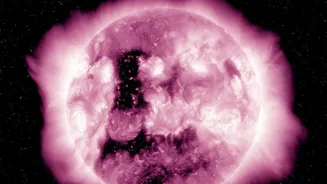
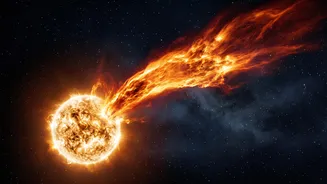
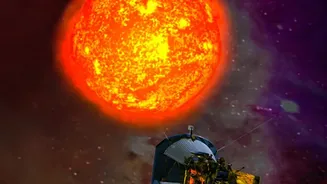
Our sun, the star that makes life on Earth possible, occasionally unleashes powerful bursts of energy. These events, known as solar flares or coronal mass ejections (CMEs), send a stream of charged particles hurtling through space. When this 'space weather'
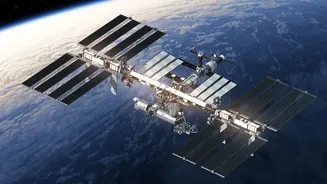
hits Earth, it can have devastating consequences. While our planet's magnetic field protects us from direct harm, these geomagnetic storms can wreak havoc on the technology we rely on every day. They can induce powerful electrical currents in the ground, potentially overloading power grids and causing widespread blackouts. They also pose a serious risk to satellites, which are crucial for everything from GPS navigation and telecommunications to banking and weather forecasting.
A Race Against an Invisible Force
For decades, predicting exactly when and where a solar storm will impact Earth has been a major challenge. The particles travel at incredible speeds, giving us very little time to prepare. Previous forecasting models were either too slow or could only provide forecasts for specific, localized areas. This meant that by the time we knew a significant storm was hitting, it was often too late for power grid operators or satellite controllers to take effective protective measures. This lack of timely, precise, global warning has been a critical vulnerability for our increasingly interconnected infrastructure.
Enter DAGGER, The AI Forecaster
This is where a groundbreaking new AI model called DAGGER comes in. The name stands for Deep Learning Geomagnetic Perturbation, and it was developed by an international team in a partnership that includes NASA. The model uses a form of artificial intelligence called deep learning to analyze real-time data on the solar wind—the constant stream of particles from the sun—collected by various spacecraft. By recognizing complex patterns in this data, DAGGER can predict the specific locations on Earth that will be affected by a geomagnetic disturbance with a crucial 30-minute advance warning. Its predictions can be generated in under a second and are updated every minute, offering a rapid and precise global forecasting system unlike any before.
Why This Matters for India
For a nation like India, which is rapidly expanding its digital infrastructure and space-based capabilities, this technology is more than just a scientific curiosity. A 30-minute warning is a game-changer. It provides just enough time for utility companies to take steps to protect the power grid, for satellite operators to move their assets to safer orbits or put them in a safe mode, and for telecommunication networks to prepare for potential disruptions. One of the lead authors on the paper, Vishal Upendran, is from the Inter-University Center for Astronomy and Astrophysics in India, highlighting the global and collaborative nature of this effort. As India continues to rely more heavily on technology for its economic growth, from digital payments to advanced agricultural techniques using GPS, the ability to mitigate the effects of space weather becomes a matter of national importance.