


A Landmark Investment in Physical AI
Eka Robotics, a startup building AI models for robotic manipulation, has successfully raised $150 million in a Series A funding round. The round was co-led by prominent venture capital firms Andreessen Horowitz (a16z) and F-Prime, with continued support
from seed investors and other strategic partners. This substantial investment values the company at an impressive $1.45 billion, signaling intense investor belief that the next frontier for AI lies not just in processing data, but in interacting with the physical world. The capital injection is earmarked to help Eka scale its technology, expand its team, and accelerate the deployment of its robots with commercial customers.
More Than Just Sight: The Vision-Force-Action Model
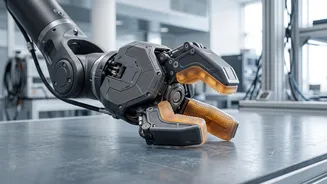
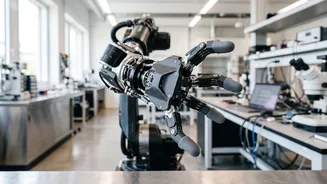
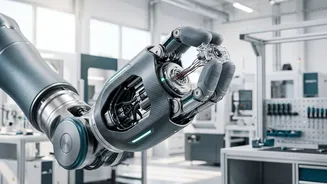
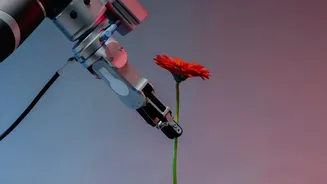
For years, a key challenge in robotics has been 'dexterous manipulation'—the ability for a machine to handle unfamiliar objects with the right amount of pressure and precision. Eka’s breakthrough is a system it calls a 'vision-force-action' (VFA) model. While many robots rely solely on cameras (vision) to guide their actions, Eka integrates advanced force sensors into its custom-designed grippers. This allows the robot to 'feel' an object, detecting slip, texture, and fragility in real-time. The AI then uses this sensory feedback to adjust its grip and movement, solving what Eka's founders call the 'last millimeter problem' of grasping objects correctly. This approach moves beyond simply mimicking human actions, instead aiming to give robots a true physical intuition.
Training Robots in the Virtual World
Instead of laboriously training robots by having them watch humans perform a task, Eka employs large-scale reinforcement learning within a physics simulator. This allows the company to generate thousands of hours of robotic experience in mere minutes, exposing the AI to a vast range of objects, environments, and physical conditions. The 'intuition' developed in this virtual world is then transferred to real-world hardware. Eka reports that its systems can already pick and place objects they have never seen before at a rate of approximately 1,500 items per hour—more than double the average human speed—with over 95% reliability. Beyond just picking, the technology has been demonstrated performing more complex tasks like inserting wires and screwing in lightbulbs.
Tackling India's Industrial Automation Gap
This technological leap arrives at a crucial moment for India's industrial sector. The nation is one of the fastest-growing markets for industrial robotics, with installations reaching record highs in recent years, driven by the automotive, electronics, and plastics industries. However, India's overall 'robot density'—the number of robots per 10,000 workers—remains low compared to global averages, highlighting a massive potential for growth. Initiatives like 'Make in India' and the explosive growth of e-commerce have created immense demand for automation in manufacturing and logistics. Technologies like Eka's, which promise not just automation but adaptable and intelligent automation, are critical for building the smart factories and efficient supply chains of the future. The Indian industrial automation market is projected to grow significantly, reaching nearly USD 29 billion by 2031.
From the Lab to the Factory Floor
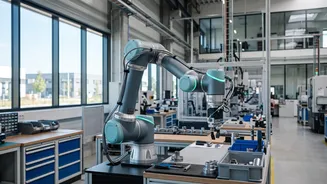
Despite the impressive lab demonstrations and investor enthusiasm, the ultimate test for Eka Robotics will be deploying its technology in real-world industrial settings. The factory floor is an unpredictable environment, and robots must perform reliably for millions of cycles without failure to provide a true return on investment. The company is already running pilot programs with industrial customers in areas like pick-and-place and wire handling. The new funding will be critical in hardening the technology for commercial use and proving that its AI-driven, force-sensitive approach can deliver sustained, reliable performance outside of controlled demonstrations. Success would not only validate Eka's multi-billion dollar valuation but also mark a pivotal moment in the evolution of physical AI.