





The Universe’s Missing Ingredient
Our understanding of the universe is governed by the Standard Model of particle physics, a triumphant theory that describes the fundamental forces and particles that make up everything we can see and touch. The problem is, this only accounts for about
25% of the matter in the cosmos. The other 75% is a mysterious, invisible substance that doesn't interact with light or ordinary matter, yet its immense gravitational pull is the only reason galaxies don't fly apart. Scientists call this 'dark matter', and its existence is one of the most significant puzzles in modern science. The Standard Model has no viable candidate for what this substance could be, which means we must look beyond our current understanding and into the realm of new physics.
Thinking Outside Our Dimensions
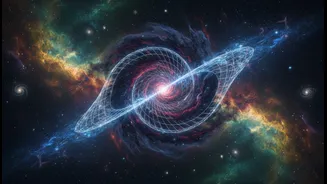
Imagine a tightrope walker. To them, the world is essentially a single line—forward and backward. But for an ant crawling on the side of the rope, there's a whole other dimension of movement: circling around the rope's circumference. Some physicists believe our universe might be similar. We perceive three spatial dimensions (length, width, height) and one of time, but there could be more, curled up so tightly we can't detect them. This idea, known as extra dimensions, isn't new. A popular version called the 'Warped Extra Dimension' (WED) model, proposed in 1999, suggests our universe could have a hidden, curved fifth dimension. This 'warping' could explain some profound mysteries, including why gravity feels so much weaker than other fundamental forces.
A Portal to the Dark Sector
This is where the new theory gets really interesting. A group of scientists in Spain and Germany proposed that this fifth dimension could be the home of dark matter. Their work suggests that certain fundamental particles, known as fermions, might be able to travel through 'portals' from our familiar dimensions into this warped fifth one. Once there, they manifest in a way that makes them behave exactly like the dark matter we've been looking for. This creates a so-called 'dark sector'—a realm of particles and forces that are invisible to us, but whose gravitational effects ripple back into our universe. It’s a compelling idea because it doesn't just invent a new particle; it uses the geometry of a hidden dimension to explain where our missing matter might be.
A More Elegant Universe?
What makes this concept particularly powerful is that it doesn't just solve one problem. Physicists have long been bothered by something called the 'hierarchy problem'—essentially, why the Higgs boson particle is so much lighter than theory predicts. By providing a new framework, this fifth-dimension theory offers a potential explanation for this discrepancy as well. Another recent theory from the University of Sheffield takes a similar approach, suggesting that dark matter particles might be 'in tune' with a hidden dimension, creating a resonance much like a musical instrument hitting the right note. This could explain why dark matter was able to interact strongly in the early universe but is so inert and hard to find today. It's an elegant solution because the resonance arises naturally from the dimension's geometry, rather than requiring physicists to artificially fine-tune their models.
Hunting for a Hidden Reality
Of course, a theory is just a theory until it's tested. So how could we possibly find evidence for a hidden dimension? The answer might lie in gravity itself. According to proponents of these theories, the existence of these extra-dimensional particles could produce incredibly faint ripples in spacetime, known as gravitational waves. Detecting such specific signals would require a new generation of powerful gravitational wave detectors, which are currently being developed and built around the world. While we are not there yet, the prospect is thrilling. The answer to one of the biggest mysteries of the cosmos could be right around the corner, waiting for us to build a machine sensitive enough to listen to the vibrations of a hidden dimension.