





Defining the Objects in Orbit
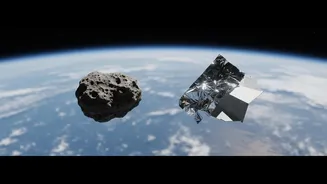
First, let's clarify the terms. Meteoroids are natural space rocks, ranging from dust grains to objects about a meter wide. They are often fragments from comets or asteroids, composed of rock, metal, or a combination. Space junk, or orbital debris, is anything
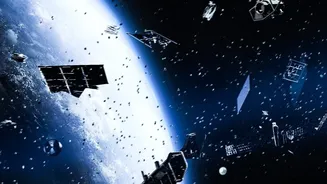
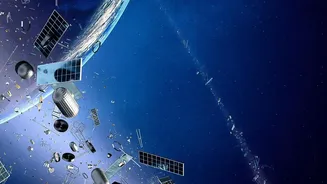
man-made left in orbit: spent rocket stages, dead satellites, and even fragments from accidental collisions. While a meteoroid is a visitor passing through, space junk is a resident, circling the Earth until it eventually re-enters the atmosphere.
Why the Distinction Is Critical
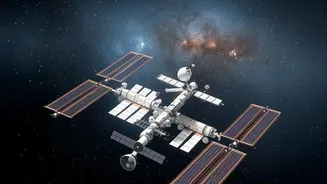
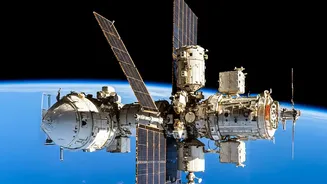
Telling these two categories apart is not just an academic exercise; it has major practical implications. Tracking space junk is essential for Space Situational Awareness (SSA), which helps protect active satellites from potentially catastrophic collisions. The International Space Station, for example, regularly performs avoidance manoeuvres to dodge debris. On the other hand, studying meteoroids provides invaluable scientific data about the composition and history of our solar system. Each type of object requires a different response: one is a hazard to be managed, the other a source of cosmic insight.
Clue 1: The Path They Travel
One of the most significant clues is an object's trajectory. Space junk follows predictable orbits around the Earth. Having been launched from our planet, these objects travel along paths that largely conform to known orbital patterns, often moving west to east. Meteoroids, originating from deep space, have much more varied trajectories and can appear from any direction. Their paths are influenced by the gravity of the Sun and other celestial bodies, not just Earth. By analyzing an object's flight path, astronomers can make a strong initial assessment of its origin.
Clue 2: It's All About Speed
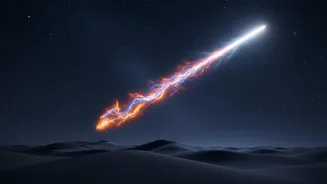
Velocity is another key differentiator. Objects in low-Earth orbit (LEO), where most space junk resides, travel at roughly 8 kilometers per second. Meteoroids, however, are significantly faster. They enter Earth's vicinity at speeds ranging from 11 to 72 kilometers per second. This high velocity is a tell-tale sign of a natural object on an interplanetary journey. The difference in speed is often so pronounced that it's one of the first indicators astronomers use to distinguish between a meteor burning up in the atmosphere and a piece of debris re-entering.
Clue 3: Uncovering Material Composition
When trajectory and speed aren't enough, astronomers turn to spectroscopy. By analyzing the light reflected from an object, or the light emitted as it burns in the atmosphere, scientists can determine its chemical makeup. Meteoroids typically show signatures of rock and metal. Space junk, in contrast, reveals its artificial origins through the presence of materials like stainless steel, aluminum, and specific types of paint or polymers like polyvinyl fluoride. These industrial materials are a dead giveaway that the object was made on Earth.
The Astronomer's Toolkit
To gather all this data, astronomers rely on a global network of sophisticated tools. Ground-based radars are excellent for tracking objects in low-Earth orbit, capable of detecting items down to a few centimeters in size. These systems send out radio waves and analyze the returning echoes to determine an object's size, shape, and orbit. For objects in higher orbits, like geostationary orbit, powerful optical telescopes are used. These telescopes track the faint glint of sunlight reflecting off distant objects, allowing their paths to be catalogued. Organizations like NASA, ESA, and ISRO are part of a global effort to monitor this traffic, using their combined assets to keep a watchful eye on the skies.