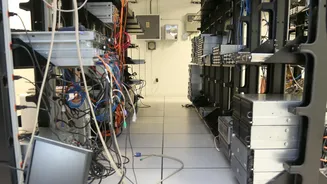









India is in the midst of a digital infrastructure gold rush, with investment commitments in the data centre sector soaring. But turning these ambitious plans into reality hinges on a critical factor: the ability to execute complex projects on time.
The Scale of the Digital Boom
India's
data centre market is expanding at an unprecedented pace. Driven by surging cloud adoption, the rollout of 5G, data localisation mandates, and the explosive growth of artificial intelligence (AI), demand for computing capacity is immense. Projections indicate that India's operational capacity, which stood at around 1.8 GW in mid-2026, could more than triple to over 6 GW by 2029 or 2030. This boom has attracted tens of billions of dollars in investment commitments from global hyperscalers like Amazon and Google, as well as domestic giants such as Adani and Reliance. State governments are actively competing to attract these projects, offering incentives around land, power, and streamlined approvals. These massive server farms are the physical backbone of the digital economy, powering everything from online banking and streaming services to complex AI models.
Announced vs. Operational: The Execution Gap
Beneath the headline-grabbing investment figures lies a more complex reality. There is a significant difference between an announced project and a fully commissioned data centre drawing power. Of the massive pipeline of planned capacity, studies suggest that only 40-50% is actively under construction. The remainder is either approved but not yet started or remains at the announcement stage. The journey from a press release to a fully operational facility can take anywhere from 30 to 48 months, and it is a path filled with potential delays. This gap between ambition and execution is where the industry's biggest challenge lies. Success is no longer just about attracting capital; it's about navigating the intricate, on-the-ground realities of building complex infrastructure in a rapidly growing market.
The Holy Trinity of Hurdles: Power, Land, and Water
The most critical bottlenecks threatening project timelines are fundamental infrastructure needs: power, land, and water. Modern data centres, especially those built for AI, are incredibly power-hungry. A single large campus can consume hundreds of megawatts, equivalent to a small city, placing immense strain on local electricity grids. Securing a reliable, high-volume power connection is often the longest and most challenging part of the development process. Land acquisition is another major hurdle. Data centres need large tracts of land in locations with robust fibre optic connectivity, but these are often in or near major cities where space is scarce and expensive. Finally, water consumption is a growing concern. Used for cooling, a 100 MW data centre can consume millions of litres of water daily, a significant issue in water-stressed urban areas like Mumbai and Chennai. As some communities begin to protest the strain on local resources, site selection has become a delicate balancing act.
The Race for Talent and Sustainability
Beyond physical infrastructure, other factors are becoming critical. The rapid expansion is creating a shortage of skilled labour capable of designing, building, and operating these highly specialised facilities. Furthermore, there is increasing pressure from investors and customers to ensure these energy-guzzling facilities are sustainable. This means not just securing power, but securing renewable power. Many operators are now entering longterm power purchase agreements for solar and wind energy and investing in advanced, waterefficient cooling technologies to reduce their environmental footprint. Meeting these environmental, social, and governance (ESG) goals is no longer optional; it is a core part of business continuity and risk mitigation.
Can Policy and Innovation Clear the Path?
To address these challenges, both government and industry are taking action. Several states have rolled out dedicated data centre policies with incentives and single-'window clearance systems to fast-'track approvals. The central government has also offered support, including a proposed long-'term tax holiday for certain cloud providers. While a unified national policy is still in the works, the designation of data centres as 'infrastructure' helps streamline financing. On the industry side, developers are adopting innovative construction methods, such as using prefabricated components, to shorten development timelines. They are also investing in their own dedicated power infrastructure and exploring new locations beyond the traditional hubs of Mumbai and Chennai to find areas with more readily available resources.