






The Old Story of Forest Survival
The conventional wisdom about tropical forests facing drought was straightforward. Scientists long believed that the sheer height of the largest trees was their greatest vulnerability. The logic seemed simple: pulling water hundreds of feet from the soil
to the highest leaves is a massive fight against gravity, a process that would become incredibly difficult when water is scarce. This struggle is known as hydraulic stress. It was assumed that during a drought, this system would fail in tall trees first, making them the most likely to die. These giants, which store a disproportionately large amount of carbon, were seen as the titans of the forest with an Achilles' heel. Climate models forecasting the future of these vital ecosystems were built on this very assumption.
A Surprising Twist in the Canopy
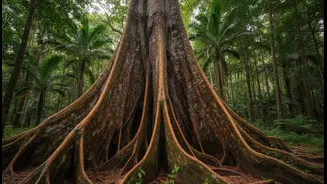
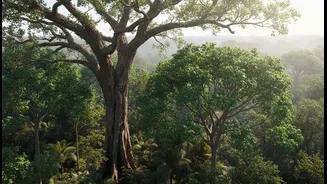
However, a recent study published in the journal 'Science' challenges this long-held belief. Researchers studying the towering dipterocarp trees in the rainforests of Borneo, some of the tallest flowering plants on Earth, discovered something astonishing. These giants, reaching heights of over 200 feet, have developed special adaptations to move water efficiently through their massive trunks. The study, led by forest ecologist Paulo Bittencourt of Cardiff University, involved an intensive effort where climbers scaled trees as tall as 30-storey buildings to collect samples. By examining these samples and monitoring growth during a recent El Niño-related drought, the team found that the tallest trees were not more affected than their shorter neighbours. Their growth didn't decline more than smaller trees, suggesting height alone isn't the deciding factor in drought survival.
Two Different Struggles, One Shared Risk
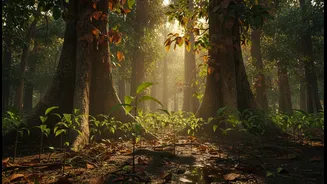
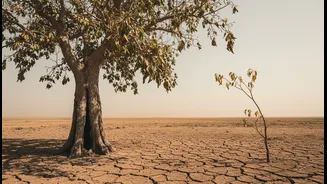
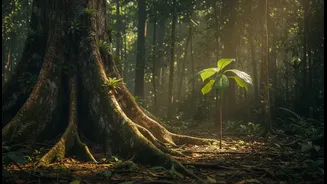
The new findings don't suggest that tropical forests are safe from drought. Instead, they reveal that trees of all sizes are at risk, but for different reasons. While the tallest trees have evolved sophisticated internal plumbing to overcome the pull of gravity, they still face the risk of hydraulic failure if a drought is severe and long enough. On the other end of the spectrum, smaller trees in the understory face a different battle. They live in a hotter, drier microclimate near the forest floor, with less access to cooling winds. Their shallower root systems mean they can't tap into deep soil moisture, making them vulnerable to what scientists call 'atmospheric thirst'—losing water to the dry air faster than they can absorb it. So, while the giants risk a plumbing failure from the inside, the smaller trees risk drying out from the outside.
A New Lens for a Hotter Future
This discovery fundamentally changes how we must forecast the future of tropical forests in a warming world. Previous models that predicted the widespread death of large trees first may have been incorrect, or at least incomplete. The new understanding suggests a more complex, mosaic-like pattern of vulnerability across the forest. The implications are significant because the largest one percent of trees in a tropical forest can hold more than half of its above-ground carbon. Accurately predicting their fate is crucial for global carbon cycle models. If both large and small trees are susceptible to different drought pressures, the overall resilience of the forest could be lower than previously thought. This shift requires scientists to re-evaluate how these ecosystems will respond as droughts become more frequent and intense due to climate change.
What This Means for India's Forests
These findings from Borneo's rainforests carry important lessons for India's own tropical treasures, such as the Western Ghats and the forests of the Northeast. These ecosystems, rich in biodiversity and crucial for regulating regional climate patterns, are also facing the escalating threat of climate change, including more intense droughts and heatwaves. The old assumption that certain trees were naturally safe is no longer a reliable guide for conservation. The new research underscores the need for a more nuanced approach to forest management and conservation efforts in India. It highlights the importance of protecting the entire forest structure, from the shortest saplings to the most ancient giants, as each part of the ecosystem faces its own unique climate-related threats. Understanding these complex dynamics is the first step toward building resilience in these vital natural landscapes for the challenging decades ahead.