


Seeing the Invisible with Infrared
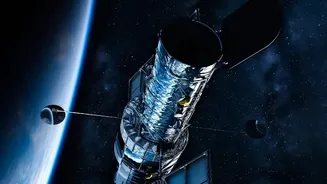
The magic behind the JWST's discoveries lies in its ability to see the universe in infrared light. Unlike visible light, which our eyes can see, infrared is a range of light that is perfect for detecting heat and observing distant, cool objects. Exoplanets,
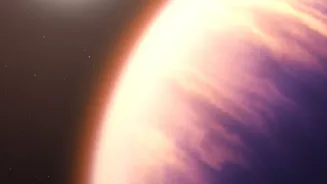
which are planets outside our solar system, don't produce their own light. They are incredibly faint and often hidden by the glare of the stars they orbit. By focusing on the infrared spectrum, the JWST can pick up the faint thermal glows of these planets and, more importantly, analyze the starlight that passes through their atmospheres.
A Cosmic Shadow Play
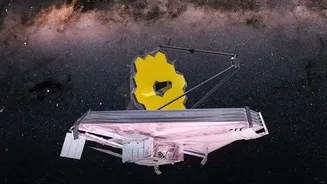
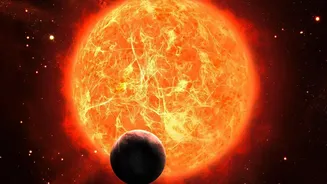
To study an exoplanet's atmosphere, astronomers often use the 'transit method.' This involves patiently watching a star and waiting for a planet to pass in front of it from our perspective. When this transit happens, the planet blocks a tiny fraction of the starlight, causing a minuscule dip in the star's brightness. This event is the key opportunity. As the starlight streams through the upper layers of the planet's atmosphere, the gases present absorb some of that light before it continues its journey to the JWST's mirrors. The telescope is so sensitive it can detect these subtle changes, which hold the chemical secrets of the planet's sky.
Decoding the Chemical Fingerprints
This technique is called transmission spectroscopy. Think of it like a barcode scanner for planets. Every chemical element and molecule—like water, methane, or carbon dioxide—absorbs very specific wavelengths, or colors, of infrared light. When the starlight passes through the atmosphere, these chemicals leave behind a unique 'fingerprint' by removing the light at their specific wavelengths. The light that reaches the JWST is therefore missing certain colors. By breaking the light down into a spectrum—similar to a rainbow—scientists can see which wavelengths are missing. These missing pieces, or absorption lines, tell them exactly what gases are present in the planet's atmosphere.
Case Study: The Intriguing Air of K2-18 b
A fascinating example of this in action is the exoplanet K2-18 b, located 124 light-years away. It's a 'sub-Neptune' planet, larger than Earth but potentially a 'Hycean' world with a water ocean under a hydrogen-rich atmosphere. Using transmission spectroscopy, the JWST detected the clear presence of carbon-bearing molecules, including methane and carbon dioxide, in its atmosphere. These initial observations also found a shortage of ammonia, which supports the theory of a water ocean. Excitingly, some data hinted at the possible presence of dimethyl sulfide (DMS), a molecule that on Earth is overwhelmingly produced by life, particularly marine phytoplankton. While this is far from a confirmation of alien life, it demonstrates the incredible power of the JWST to identify potential biosignatures from across the galaxy.
From Data to a Fuller Picture
The analysis doesn't stop at just identifying chemicals. The relative amounts of different molecules can tell scientists about the planet's history, its formation, and even its weather. For instance, on the 'hot Saturn' exoplanet WASP-39 b, the JWST found a surprising amount of sulfur dioxide. This discovery was the first concrete evidence of photochemistry—chemical reactions triggered by starlight—on an exoplanet. The rich chemical inventory, including carbon dioxide, water, and potassium, suggests the planet may have formed from the crashing together of smaller bodies. These detailed atmospheric profiles are helping astronomers build a more complete understanding of the diversity of planets in our galaxy.