


The Unforgiving Lunar Night
For every 14 days of sunlight, the Moon experiences 14 days of darkness. Without an atmosphere to retain heat, surface temperatures plummet drastically, reaching as low as -173 degrees Celsius (-280 degrees Fahrenheit) and even colder in permanently shadowed
regions near the poles. This extreme cold is one of the single greatest challenges for sustained lunar exploration. Standard electronics and batteries, which are essential for landers, rovers, and scientific instruments, are not designed for such conditions. The cold can make materials brittle, cause solder joints to fracture, and slow down the chemical reactions inside batteries until they stop working entirely. Historically, this has meant that many lunar missions are designed to end when the first long night falls.
A Constant Source of Warmth
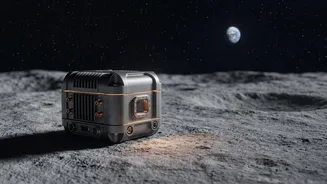
To solve this problem, space agencies and private companies rely on a clever solution: self-heating power modules. The most proven of these are Radioisotope Heater Units, or RHUs. These small devices, often no bigger than a C-cell battery, act like tiny, long-lasting furnaces. An RHU contains a small pellet of a radioactive isotope, most commonly plutonium-238. As the isotope naturally decays over decades, it releases a steady, predictable amount of heat. By strategically placing these units within a spacecraft or rover, engineers can keep sensitive components like computers, circuit boards, and batteries within their operational temperature range, even when the outside environment is lethally cold.
How Radioisotope Heaters Work
The genius of the RHU is its simplicity. It has no moving parts and requires no electrical input to function, making it incredibly reliable. A single unit typically generates about one watt of thermal energy. This might not sound like much, but in the vacuum of space, it’s enough to make a critical difference. The heat is transferred directly to the components that need it most, preventing them from freezing. This allows mission designers to allocate the lander's precious electrical power, typically from solar panels and batteries, to running scientific instruments and communication systems rather than diverting it for electrical heating. RHUs have been a workhorse for space exploration, used in missions from the Apollo era's lunar experiments to the Mars rovers Spirit and Opportunity.
The Next Generation of Lunar Heaters
While plutonium-based RHUs are a proven technology, new innovations are emerging. Some companies, like Zeno Power, are developing heaters that use different isotopes, such as americium-241. Americium has a much longer half-life than plutonium, though with lower power density, and is seen by some as a safer alternative that can be produced on demand. Other approaches look beyond radioisotopes entirely. Advanced thermal blankets and insulation, like the Integrated Multi-Layer Insulation (IMLI) being tested by NASA, can help retain heat and keep internal components at a stable temperature without an active heat source. Another innovative concept combines a loop heat pipe (LHP) with an electrohydrodynamic pump, creating a switchable system that can dissipate heat during the hot lunar day and then turn off to insulate electronics during the cold night, using very little power.
Enabling a Permanent Lunar Presence
Surviving the lunar night is not just about keeping one rover going; it's about enabling a fundamental shift in lunar exploration. The ability to operate continuously through day-night cycles is essential for NASA's goal of establishing a long-term human and robotic presence on the Moon. Technologies like self-heating modules and advanced thermal management make it possible to build permanent lunar bases, conduct uninterrupted scientific research, and explore regions that were previously inaccessible, like the permanently shadowed craters believed to hold water ice. By solving the problem of the extreme cold, these power modules are unlocking a new era of sustainable exploration, turning the Moon from a place of brief visits into a permanent outpost for humanity.