








The Mistake: Overly Creative Formatting
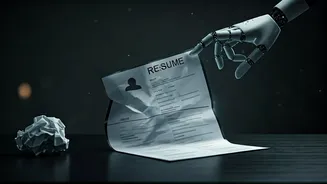
A resume that looks beautiful to the human eye can be completely unreadable to an Applicant Tracking System (ATS). These AI-powered systems, used by the vast majority of large companies, struggle to parse complex layouts. Elements like columns, tables,
text boxes, images, and logos can confuse the software, causing it to scramble or completely ignore critical information like your job titles and dates. If the machine can't read your experience, it assumes you don't have any. The result is an automatic rejection before a recruiter ever sees your name.
The Fix: Embrace Simplicity and Structure
The solution is to think like a machine: linear and logical. Stick to a clean, single-column format that reads from top to bottom. Use standard, easy-to-read fonts like Arial, Calibri, or Helvetica. Replace creative headings like "My Professional Journey" with standard, predictable titles that the AI is programmed to recognize, such as "Work Experience," "Education," and "Skills." This ensures the system can correctly extract and categorise your information, giving you a fair chance at being seen by a human reviewer.
The Mistake: Using the Wrong Keywords (Or Too Many)
An ATS works by scanning your resume for specific keywords and phrases that match the job description. If your resume talks about being a "brand storyteller" while the job post asks for a "content marketing manager," the system may not connect the dots. On the other hand, "keyword stuffing"—cramming your resume with dozens of repeated terms in an attempt to trick the system—is also a major red flag. Modern AI is sophisticated enough to detect this unnatural language and will often penalise your application for it.
The Fix: Mirror the Job Description Naturally
The key is strategic alignment, not brute force. Carefully read each job description and identify the top 10-15 key skills, tools, and qualifications the employer mentions. Then, incorporate these exact phrases naturally into your own experience descriptions. For example, if a posting requires experience with "Salesforce," make sure that exact term appears in your resume, not just "CRM software." This shows the AI that your skills are a direct match for what the company is looking for, significantly increasing your ranking.
The Mistake: Vague Descriptions and Unquantified Achievements
Statements like "Responsible for sales" or "Improved team efficiency" are meaningless to both AI and human recruiters. These phrases lack context and fail to demonstrate your actual impact. The AI is looking for concrete evidence of your abilities, and without it, your resume lacks the substance to score well. Furthermore, when a human eventually reads your resume, they need to see clear, measurable accomplishments to be impressed.
The Fix: Quantify Everything with Numbers and Action Verbs
Transform your responsibilities into achievements. Instead of saying you were "responsible for marketing," state that you "Led a three-month email campaign that increased qualified leads by 25%." Use powerful action verbs to start each bullet point and include specific metrics, percentages, and figures whenever possible. This provides concrete proof of your value and is easily interpreted by both the ATS and the hiring manager. Every bullet point that lacks a number is a missed opportunity to showcase your impact.
The Mistake: Choosing the Wrong File Type
This seems like a small detail, but it can be an instant disqualifier. While PDFs are great for preserving your layout for human eyes, some older ATS platforms can struggle to parse them correctly. Submitting a file that the system can't open or read is the digital equivalent of handing in a blank piece of paper. If the company provides specific instructions on file types, ignoring them shows a lack of attention to detail.
The Fix: Follow Instructions and Default to .docx
Always read the application instructions carefully. If the employer requests a specific format like .docx, use it. If no format is specified, a Microsoft Word document (.doc or .docx) is often the safest bet, as it is universally compatible with nearly all ATS systems. Before submitting, you can even test how your resume will be seen by an ATS by saving it as a plain-text (.txt) file. This strips away all formatting and shows you the raw information the machine will likely parse.