

Peering into Cosmic Cradles
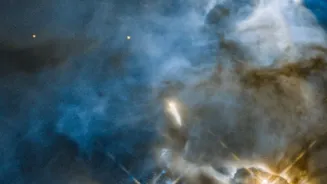
Across our galaxy, vast, beautiful clouds of gas and dust known as stellar nurseries drift through space. These are the places where stars are born. For centuries, they have captivated astronomers, but the very dust that fuels star birth also acts as a thick
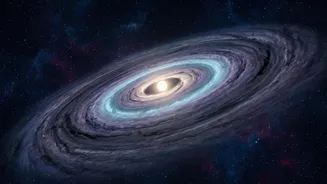
veil, hiding the earliest stages of creation from view. Within these dense clouds, gravity pulls material into collapsing knots that heat up and ignite, forming protostars. Think of it as a cosmic construction zone, bustling with activity but shrouded in mystery. Many of these young stars are surrounded by swirling platters of leftover gas and dust, called protoplanetary disks, the very locations where planets are assembled.
Webb’s Infrared Superpower
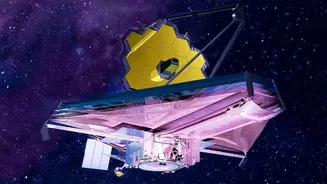
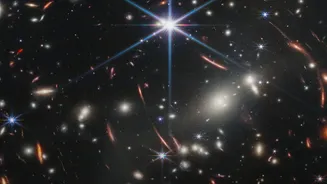
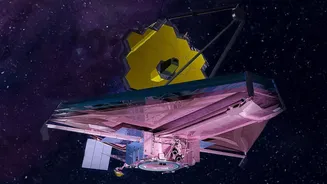
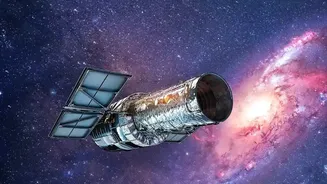
This is where the James Webb Space Telescope changes everything. Unlike the Hubble Space Telescope, which primarily sees visible light, JWST is designed to detect infrared light. This gives it a unique superpower: the ability to see through the obscuring dust clouds. Light from newborn stars and their forming planets can travel for thousands of light-years, but by the time it reaches us, the expansion of the universe has stretched its wavelength into the infrared spectrum. JWST’s giant mirror and sensitive instruments are perfectly tuned to capture this faint, ancient light, allowing scientists to study processes that were previously invisible. It can resolve details in the terrestrial planet-forming regions of these disks, which are typically not resolvable from the ground.
The Blueprint of a New World
So, what is Webb actually seeing? It's observing the chemical and physical conditions inside these protoplanetary disks. By analysing the light that passes through them, astronomers can identify the chemical fingerprints of various molecules. Recent observations have revealed a surprising diversity in the composition of these disks. Some are rich in water and carbon dioxide, while others are dominated by hydrocarbons like benzene. These discoveries are crucial because the chemical environment of a disk determines what kind of planets can form there. In some systems, Webb has even detected powerful winds and jets of gas being ejected by the young star, a chaotic process that shapes how and when planets can assemble their atmospheres.
From Dust to Planets
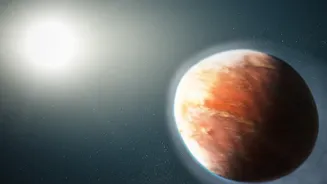
Planet formation is a race against time. The process begins with tiny dust grains in the protoplanetary disk sticking together. Over millions of years, these clumps grow from pebbles into larger bodies called planetesimals, and eventually into full-fledged planets. However, this process is constantly competing with forces that are trying to blow the disk apart, like radiation and stellar winds from the central star. JWST’s observations are helping scientists understand this timeline. Studies of dozens of young stars show that the gas needed to form giant planets like Jupiter disappears relatively quickly. In some stellar nurseries, like NGC1333, Webb has directly observed Jupiter-sized infant worlds, giving us a snapshot of this process in action.
Why This Cosmic Detective Work Matters
Studying the birth of distant planets isn't just an academic exercise; it's a way of understanding our own origins. The chemical ingredients Webb is finding in these disks—water, carbon dioxide, complex organic molecules—are the same ones that were present in our own solar system 4.5 billion years ago. By observing a wide variety of these stellar nurseries, astronomers can piece together the different pathways that lead to planetary systems. Some might end up like ours, while others may form in completely different ways. This research helps us understand the conditions that might make a planet habitable and provides invaluable context in the ongoing search for life beyond Earth.