




Meet Shukrayaan: India's Next Giant Leap
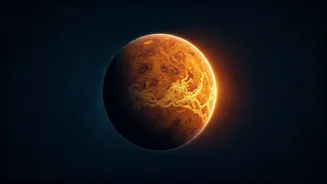
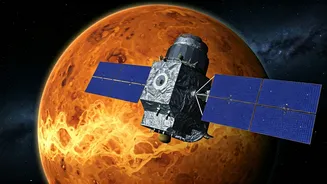
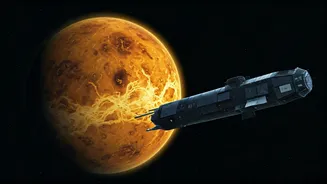
After its celebrated missions to the Moon and Mars, ISRO is turning its gaze to the second planet from the Sun. The Venus Orbiter Mission, unofficially known as Shukrayaan, is India's first mission to our mysterious neighbour. Officially approved by the Indian
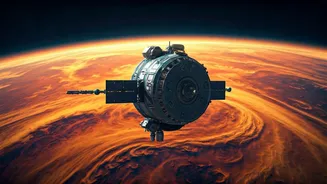
government in September 2024, the mission is now slated for a March 2028 launch. The plan is to send a 2,500 kg spacecraft, packed with around 100 kg of scientific instruments, into a four-year-long orbit around Venus. This ambitious project aims to peel back the layers of Venus’s thick atmosphere and study its surface, providing crucial data that could rewrite our understanding of how planets evolve. The mission represents a major step in India's space program, positioning it as a key player in interplanetary exploration.
The Tale of Two Twins
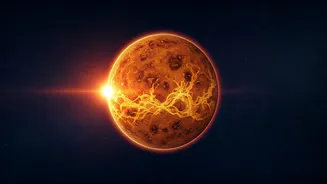
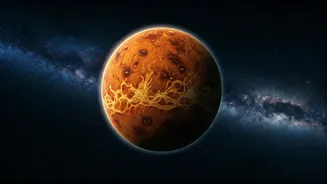
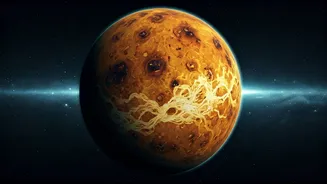
The term 'Earth's twin' isn't just a casual nickname. Venus and Earth are remarkably similar in size, mass, density, and composition, suggesting they were formed from the same cosmic materials around the same time. But that’s where the similarities end. Venus suffers from a runaway greenhouse effect, with a thick, toxic atmosphere of carbon dioxide and clouds of sulfuric acid. This traps heat, roasting its surface at an average of 467 degrees Celsius — hot enough to melt lead. The atmospheric pressure is over 90 times that of Earth's at sea level. Scientists believe Venus may have once had liquid water oceans, much like early Earth. The fundamental scientific question, therefore, is what caused this dramatic divergence? Understanding this process is not just about Venus; it provides a crucial natural laboratory for studying extreme climate change, offering lessons that could be vital for Earth's future.
ISRO's Scientific Toolkit
To solve these mysteries, Shukrayaan will carry a powerful suite of instruments developed both in India and through international collaborations with countries like Sweden, Germany, and Russia. One of the key instruments is a high-resolution Synthetic Aperture Radar (SAR). Since Venus is perpetually shrouded in thick clouds, optical cameras are useless for seeing its surface. SAR uses radar waves to pierce through the clouds and create detailed maps of the planet's topography, searching for clues about its geological history, including signs of currently active volcanoes. Another groundbreaking instrument will be a ground-penetrating radar, a world-first for Venus, designed to study the planet's subsurface. Other payloads will focus on the atmosphere, analysing its chemical composition, the dynamics of its super-rotating winds, and its interaction with the solar wind.
The Search for Answers
Shukrayaan's core objectives are ambitious and layered. Firstly, the mission will create high-resolution maps of Venus's surface and sub-surface, updating data from NASA's Magellan mission from the 1990s with much greater detail. This will help scientists understand the volcanic and tectonic processes that have shaped the planet. Secondly, it will investigate the chemistry of the dense atmosphere. This includes studying the mysterious super-rotation, where the atmosphere circles the planet in just four Earth days, and looking into the controversial 2020 finding of phosphine gas — a potential, though highly debated, indicator of microbial life. Thirdly, since Venus lacks a protective global magnetic field like Earth's, Shukrayaan will study how the solar wind directly interacts with its upper atmosphere and strips particles away, providing insights into atmospheric loss on planets.