



The Cosmic Rules of Black Holes
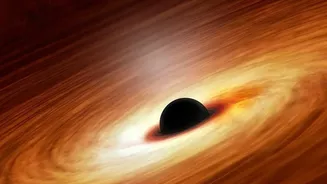
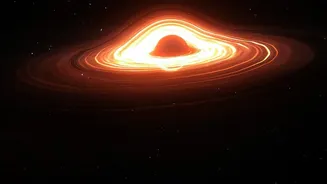
For decades, physicists have understood black holes as objects that merge but never divide. This understanding is rooted in fundamental physics, particularly the second law of thermodynamics. A key property of a black hole is its entropy, which can be
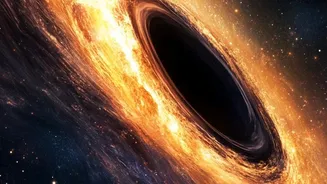
thought of as a measure of its internal disorder. For a stationary black hole, splitting into two smaller ones would decrease the total entropy, a process that is considered thermodynamically unfavourable and essentially forbidden by the laws of physics as we know them. This principle, closely related to Stephen Hawking's area theorem, states that the surface area of a black hole's event horizon—its boundary of no escape—should never decrease. Because of this, the idea of a black hole breaking apart has long been dismissed as impossible.
A Loophole Called 'Spin'
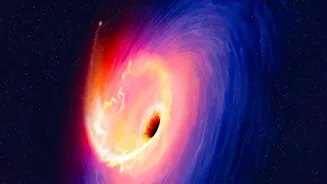
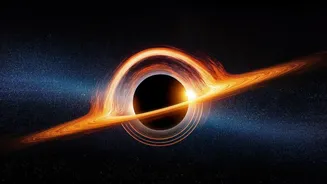
The game changes, however, when a black hole is spinning. A new theoretical study, published in the journal Physical Review D, explores what happens when a black hole rotates at or near its maximum possible speed. The researchers found that extreme rotation alters the relationship between a black hole's mass and its entropy. A rapidly spinning black hole has less entropy than a non-spinning one of the same mass. This creates a theoretical 'loophole': if the spin energy could be converted into the orbital energy of two separate, smaller black holes, the split might become thermodynamically possible without violating the fundamental rule of increasing entropy.
The 'Pair-of-Pants' Split
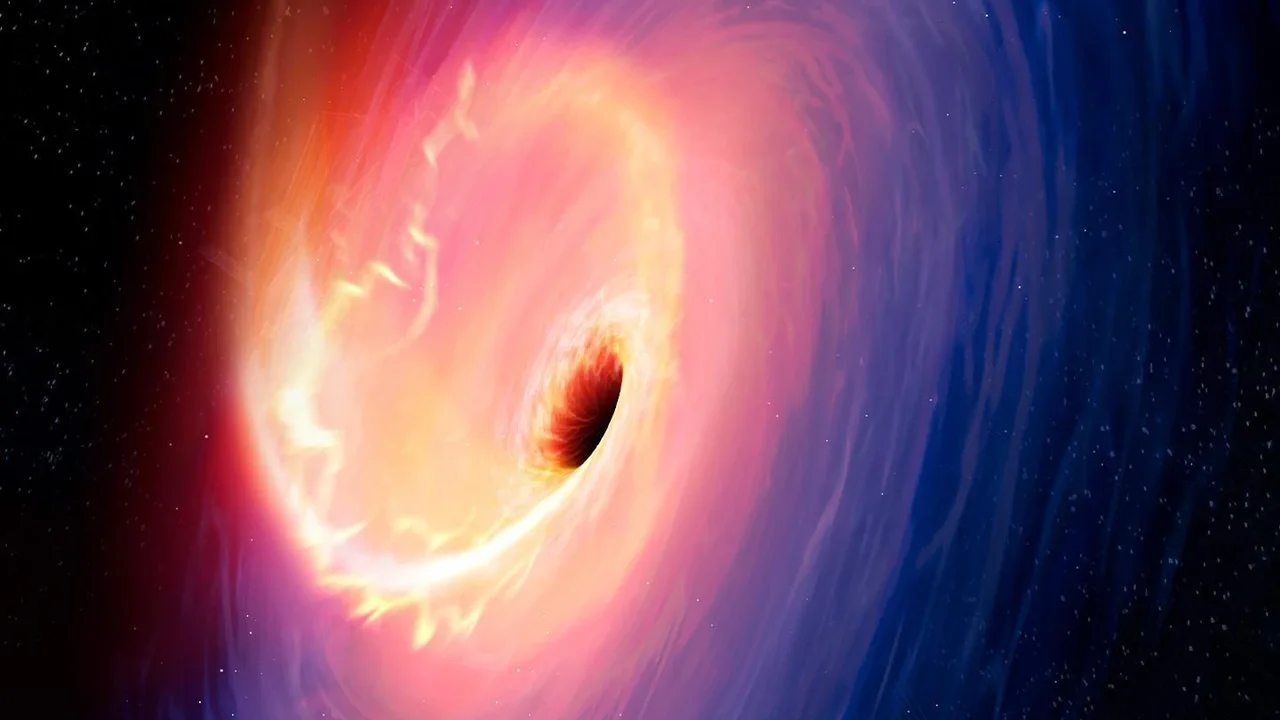
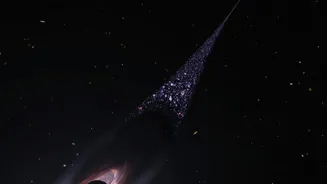
According to the study, for this split to happen, the conditions must be incredibly specific. The black hole must be rotating at, or very close to, its absolute maximum speed limit. Under this extreme stress, its event horizon could deform, elongating and forming a shape the researchers describe as a 'pair-of-pants topology'. Imagine the single event horizon branching into two 'legs' through spacetime, with each leg eventually becoming a new, smaller black hole. However, there's another catch. The two newly formed black holes must also have enough momentum to fly apart, otherwise their mutual gravity would simply cause them to merge back together almost instantly. This requirement makes the window for a successful split exceptionally narrow.
Why This Is a Big Deal
While purely theoretical for now, this research challenges long-held assumptions about the life cycle of black holes. For decades, they have been seen as objects that only grow, either by consuming matter or by merging with other black holes. The possibility of splitting, even if exceedingly rare, introduces a new dynamic. Researchers suggest that smaller, primordial black holes, which may have formed shortly after the Big Bang, could be more likely candidates for this process than the supermassive black holes found at the centres of galaxies. If such an event were to occur, it would be incredibly violent, sending powerful gravitational waves rippling through the fabric of spacetime. These ripples would have a unique signature, different from those created by merging black holes, which observatories like LIGO could potentially detect.