
A Legacy of Watching the Giants
For over three decades, the Hubble Space Telescope has been humanity's persistent eye in the sky. While famous for its stunning visible-light images, its power extends far beyond what we can see. A special project called the Outer Planet Atmospheres Legacy
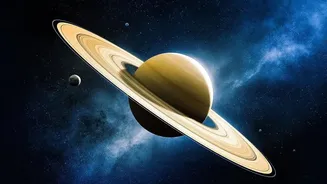
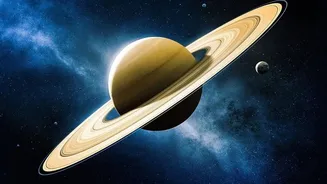
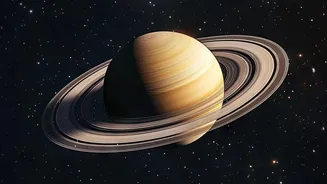
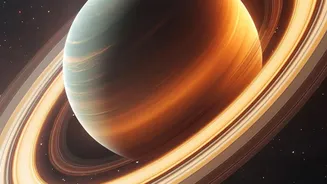
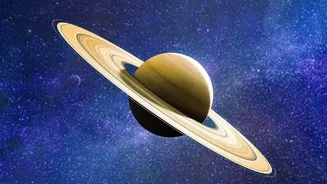
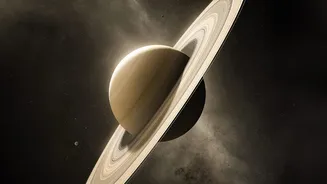
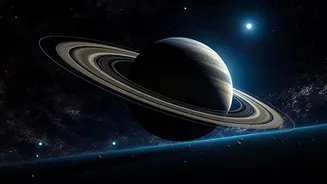
(OPAL) program has been using Hubble to conduct yearly check-ups on our solar system's gas giants: Jupiter, Saturn, Uranus, and Neptune. The goal is to build a long-term record of their weather, understanding how their massive atmospheres evolve over time. For Saturn, this annual monitoring, which began in earnest after the Cassini mission ended in 2017, provides a crucial baseline for tracking changes across its long, seven-year seasons. Recent observations from 2024 are part of this ongoing story, capturing the planet as it moves towards its 2025 equinox.
The Power of Seeing in Infrared
So, how does Hubble track these shifts? The key is infrared light. While visible light shows us the top layers of Saturn's clouds and haze, infrared radiation can peer deeper. Think of it like a special kind of vision that can see through fog. This allows scientists to sense heat and probe different altitudes within the atmosphere, revealing structures and chemical signatures that are otherwise hidden. By observing in different infrared wavelengths, astronomers can effectively 'slice' through Saturn’s atmosphere, mapping temperature changes, cloud depths, and the presence of molecules like methane and ammonia. These observations, combined with data from other observatories like the James Webb Space Telescope, create a comprehensive, three-dimensional view of how the planet's atmospheric system works.
Tracking Storms and Shifting Seasons
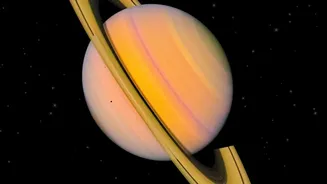
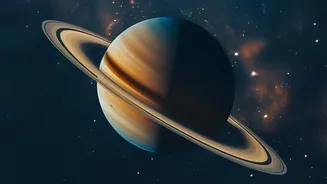
The latest images have revealed just how dynamic Saturn is. In new infrared views, scientists can see a long-lived jet stream known as the 'ribbon wave' in the northern hemisphere. They can also spot the lingering remnants of a massive disturbance from over a decade ago, called the 'Great Springtime Storm' of 2010-2012. The persistence of these features provides a natural laboratory for understanding how energy moves through such a massive atmosphere. As Saturn's seasons change, so do its colours and cloud bands. Hubble has tracked how a reddish haze can appear over the northern hemisphere, possibly due to increased heating from sunlight during its summer. Even the planet’s famous north polar hexagon, a massive six-sided jet stream, shows subtle changes that are now being monitored.
The Enigma of the Ring Spokes
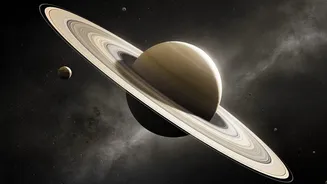
Beyond the atmosphere itself, Hubble's keen eye has helped solve a long-standing mystery in the rings: the ghostly 'spokes'. First spotted by the Voyager spacecraft in the 1980s, these are transient, radial features that appear to rotate along with the rings, lasting for only a few hours before fading. For years, their cause was unknown. The long-term monitoring from the OPAL program has confirmed that the appearance of these spokes is seasonal. They become more frequent and prominent around the time of Saturn's equinox, which happens when the rings are tilted edge-on to the Sun. This seasonal pattern provides strong clues for scientists working to explain the forces, likely related to the planet's magnetic field interacting with ring particles, that create these enigmatic features. The current 'spoke season' is offering an unprecedented opportunity to study them in detail.