



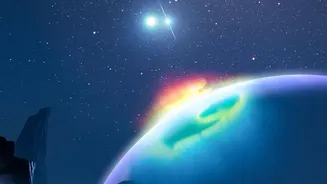
What is a 'Warm Neptune'?
In the cosmic zoo of exoplanets, there are categories we recognise, like rocky worlds and gas giants. But the most common type of planet found so far is one that doesn't exist in our own solar system: the 'sub-Neptune' or 'mini-Neptune'. These are worlds larger
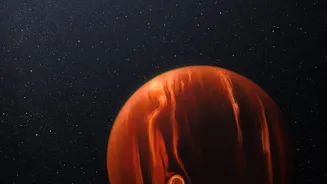
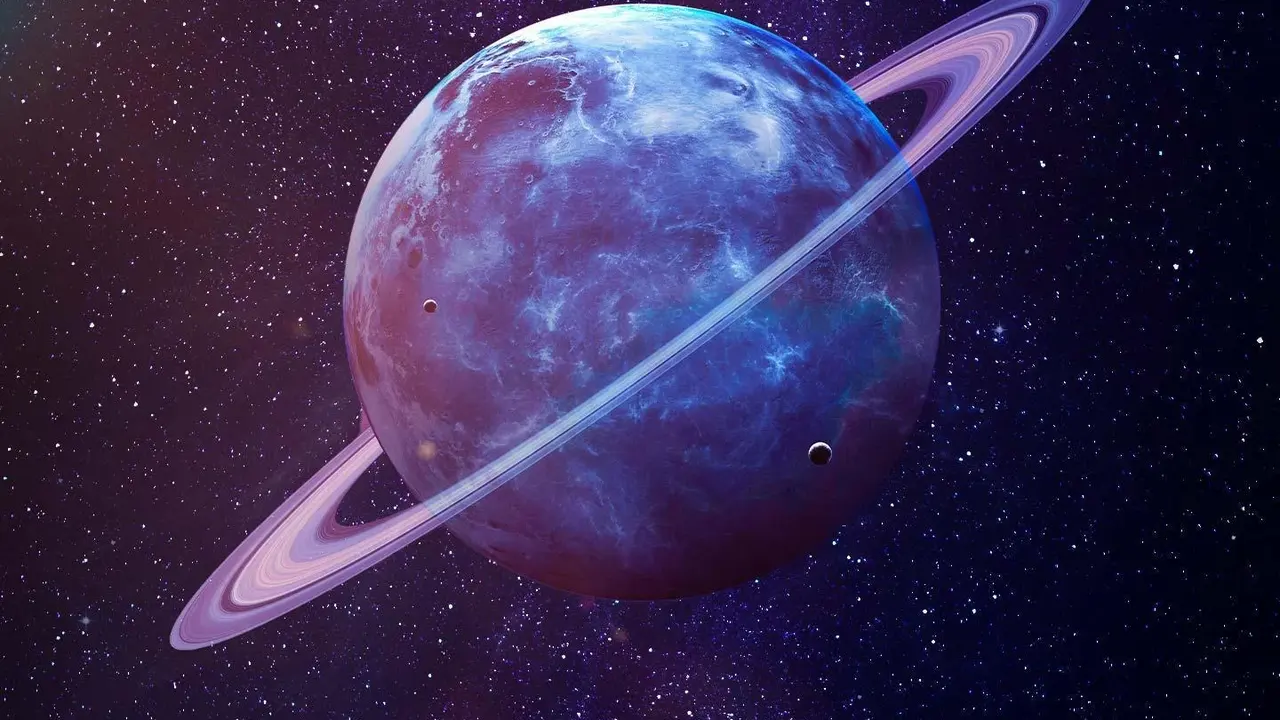
than Earth but smaller than Neptune, and they represent a mysterious middle ground. A 'warm Neptune' is a subtype of this class, a gas-rich planet that orbits relatively close to its star, making it warmer than the ice giants Uranus and Neptune in our cosmic backyard. For a long time, these planets were largely overlooked in the search for life. Their thick, hydrogen-heavy atmospheres and immense pressures were thought to make them inhospitable. The focus remained firmly on finding a 'Goldilocks' planet: a rocky world at the perfect distance from its star for liquid water to exist on its surface.
A Whiff of Something Interesting
The game changed thanks to the unparalleled power of the James Webb Space Telescope (JWST). By analysing the starlight that passes through an exoplanet's atmosphere, the telescope can detect the chemical fingerprints of different gases. In the atmosphere of a sub-Neptune exoplanet named K2-18 b, located 120 light-years away, JWST didn't just find water vapour; it detected the clear signature of methane. On Earth, methane is a powerful biosignature; while it can be produced by geological processes, the vast majority of it is generated by living organisms. This discovery was significant because methane had been surprisingly difficult to find on exoplanets before JWST, despite expectations. Its presence immediately raised questions: what is producing methane on a world so different from our own?
Rewriting the Rules of Habitability
Finding methane on a warm Neptune challenges the very definition of a habitable planet. It suggests that the conditions necessary for life—or at least the chemical precursors to it—might not be restricted to Earth-like rocky planets. The discovery on K2-18 b has bolstered a new theory of 'Hycean' worlds—planets with hydrogen-rich atmospheres and vast liquid water oceans. Previously, it was assumed that a thick hydrogen atmosphere would create surface pressures and temperatures far too high for life. However, new models suggest that a global ocean under such an atmosphere could maintain habitable conditions. The presence of methane, along with the absence of ammonia, strongly supports the hypothesis that K2-18 b could indeed have a massive ocean beneath its gassy veil. This forces us to expand our search from the traditional habitable zone and consider entirely new planetary environments.
A Clue, Not a Confirmation
It is crucial to be clear: finding methane is not proof of alien life. Methane can be produced by non-biological processes, such as interactions between rock, water, and planetary heat. Scientists need to rule out these abiotic sources before they can consider a biological origin. Furthermore, the initial JWST observations of K2-18 b also contained a tantalising, though not yet confirmed, hint of another gas called dimethyl sulphide (DMS). On Earth, DMS is produced almost exclusively by marine life, specifically phytoplankton. If its presence is confirmed with further observations, the case for habitability on K2-18 b would become dramatically stronger. For now, however, it remains a fascinating possibility that requires more data. The detection is a powerful demonstration of JWST's capability and a signpost pointing toward a new, exciting direction in astrobiology.