









The Anatomy of a Modern Classic
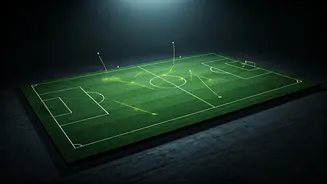
So, what exactly is the 4-2-3-1? On paper, it’s simple: a backline of four defenders, two holding or central midfielders, a line of three attacking midfielders, and one lone striker up top. But its genius lies in the roles and relationships between these
players. The two holding midfielders, often called the 'double pivot', act as a protective screen for the defence while also initiating attacks. Ahead of them, the three attacking midfielders are the creative engine. The central player, the classic 'Number 10', operates in the space between the opponent's defence and midfield, while the two wide players can act as traditional wingers or cut inside to shoot. This structure provides a formidable balance between defensive solidity and offensive firepower.
Solving the 4-4-2 Problem
To understand the 4-2-3-1's rise, you have to look at what came before it: the rigid, two-bank system of the 4-4-2. For decades, the 4-4-2 was the default formation in many parts of the world. However, savvy managers realised it had a weakness. A team playing 4-2-3-1 automatically creates a 'plus one' advantage in central midfield (three central midfielders vs. the 4-4-2's two). This numerical superiority allows a team to dominate possession and control the tempo of the game. Furthermore, the positioning of the attacking midfielder in the 4-2-3-1 puts immense pressure on the opponent's defensive midfielders, forcing them into difficult decisions and creating gaps for attackers to exploit. It was a tactical evolution that left the old guard struggling to keep up.
The Era of the Specialist
The formation's success was popularised by a generation of iconic managers and players. José Mourinho is perhaps most synonymous with it, building formidable, counter-attacking machines at Chelsea, Inter Milan, and Real Madrid. His teams were defensively robust, thanks to the double pivot, and lethal on the break, with a creative genius like Wesley Sneijder or Mesut Özil pulling the strings as the Number 10. Germany’s 2014 World Cup-winning side was another perfect example, with Bastian Schweinsteiger and Sami Khedira providing the base for Toni Kroos, Mesut Özil, and Thomas Müller to wreak havoc. The 4-2-3-1 didn't just win trophies; it created a platform for a new generation of tactical specialists to thrive.
Why It Became the Default
Coaches around the world fell in love with the 4-2-3-1 for one key reason: its flexibility. It’s a tactical chameleon. From a solid defensive block, it can seamlessly transition into an attack with five or six players joining the rush forward. It can be adapted for a possession-based style, as seen with Spain's national team in their golden era, or a rapid counter-attacking approach, like Jürgen Klopp’s early Borussia Dortmund side. This versatility makes it a safe and reliable choice. It provides cover in all key areas of the pitch, making the team less vulnerable to being exposed and offering a clear, structured plan for both defence and attack. For many coaches, it became the perfect tactical blueprint.
The Legacy in a Post-Peak World
Has the 4-2-3-1 truly 'taken over' modern football forever? Not exactly. The tactical world never stands still. The rise of the high-pressing 4-3-3, perfected by managers like Pep Guardiola and Jürgen Klopp in recent years, has challenged its dominance. Formations using three centre-backs have also made a comeback, offering a different way to control space. However, to say the 4-2-3-1 is gone would be a mistake. Its principles are now embedded in countless other systems. Many teams listed as a 4-3-3 will morph into a 4-2-3-1 when one midfielder pushes forward. The concept of the double pivot and the creative player in 'the hole' are now fundamental ideas in coaching. The formation may no longer be the undisputed king, but its influence defines the very language of modern tactics.