







Skating: Dynamic Posture in Motion
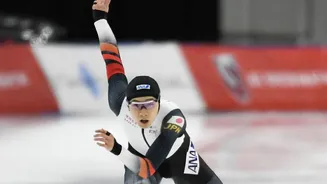
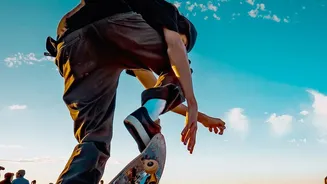
Skating, whether on ice or wheels, is fundamentally an exercise in managing instability. The correct posture is not just for aesthetics or speed; it is the foundation of control and safety. A skater’s stance is athletic and forward-focused, characterized
by a deep bend in the knees and a slight forward lean from the hips, keeping the back relatively straight. This lowers the body’s center of gravity, creating a more stable base on a narrow, low-friction surface. This 'deepest position', with significant flexion in the hips and knees, allows for powerful propulsion and the ability to absorb shocks. Core muscles, including the abdominals and lower back, are constantly engaged to keep the body upright and stable while the legs and arms move. Biomechanical studies show this dynamic stability is crucial, with trained skaters who maintain this posture experiencing significantly fewer falls. It is a posture built for generating and resisting force, enabling the skater to accelerate, turn, and stop with precision.
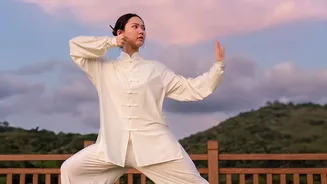
Tai Chi: Meditative Posture in Stillness
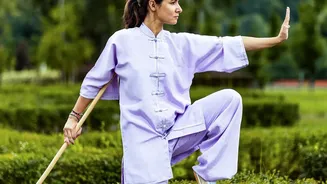
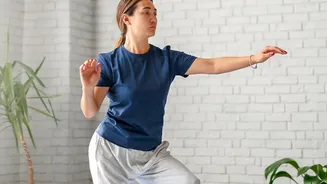
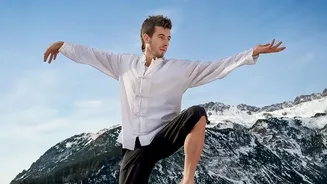
Tai Chi approaches posture from a different, more internal perspective. The ideal is an upright, relaxed alignment that feels 'grounded, not heavy; upright, not forced'. Practitioners are taught to 'straighten the head' as if suspended from above, which aligns the spine naturally. Unlike the forward lean of skating, Tai Chi emphasizes keeping the center of gravity balanced over the base of support, a principle known as 'Zhongding' or central equilibrium. The focus is on 'Song', or relaxation, releasing unnecessary tension in the shoulders and joints to allow for smooth, continuous movement. This practice enhances proprioception—the body's awareness of its position in space—by demanding mindful attention to weight shifts and alignment. The slow, deliberate motions challenge and strengthen the leg and core muscles in a sustained, low-impact manner, promoting stability from a place of calm rather than dynamic reaction.
A Contrast in Control
The postural goals of skating and Tai Chi highlight their fundamental differences. Skating posture is offensive; it’s designed to attack the ice or pavement, generate speed, and counter the forces of momentum and aerodynamics. The skater’s body is a tool for propulsion. In contrast, Tai Chi posture is defensive and receptive. It trains the body to yield, absorb, and redirect force with minimal effort, moving like a rooted tree that sways but doesn't break. Skating builds core strength through constant, rapid adjustments to maintain balance while in motion. Tai Chi builds it through sustained poses and slow, controlled transitions that require deep muscular endurance and focus. One masters stability at speed, while the other masters stability in slow, flowing grace. Studies have shown that both are highly effective; skating improves static and dynamic balance in children, while long-term Tai Chi practice helps older adults maintain postural control even when faced with external perturbations.
Common Ground: Balance, Core, and Awareness
Despite their opposing approaches, skating and Tai Chi converge on several key benefits. Both are exceptional for developing balance and strengthening the core. They demand a powerful mind-body connection, forcing practitioners to remain present and aware of their body's alignment and movement. Research confirms that both activities significantly improve postural control. Regular ice skating has been shown to counteract age-related decline in stability, with older skaters demonstrating postural control similar to that of young adults. Similarly, numerous studies have found that Tai Chi significantly reduces the risk of falls in older adults by improving balance, leg strength, and reaction time. Both disciplines prove that whether you are moving fast or slow, the key to balance lies in a well-trained posture, a strong core, and a focused mind.