





A Day That Outlasts a Year
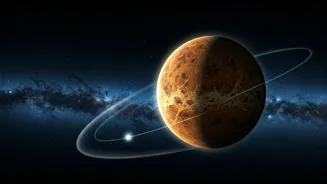
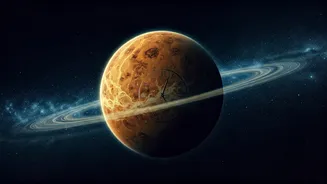
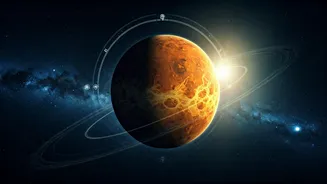
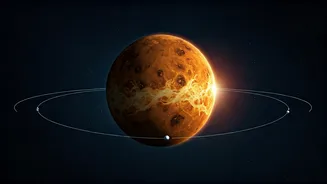
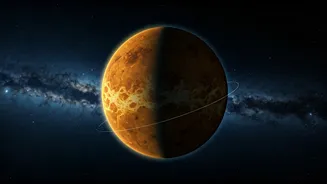
It sounds like a riddle from a science fiction story, but it's a simple, mind-bending fact. Venus completes one full orbit around the Sun in about 225 Earth days. This is its 'year'. However, it takes Venus a staggering 243 Earth days to complete just
one rotation on its axis. This is its 'day'. This means that on Venus, a day is about 18 Earth days longer than a year. Imagine celebrating your birthday before the sun has even set on the day you were born—that’s the reality on our sister planet. This bizarre timing makes Venus an outlier in our solar system, a world where the fundamental cycles of day and night are stretched to an unimaginable length.
The Slowest Spin in the Solar System
So, why is Venus such a cosmic slowpoke? Scientists have several compelling theories, but no single definitive answer. One leading hypothesis points to a colossal impact early in the solar system's history. A massive planet-sized object could have smashed into Venus, not only slowing its rotation to a crawl but also knocking it over, causing it to spin in the opposite direction of most other planets—a phenomenon known as retrograde rotation. Another powerful theory involves Venus’s incredibly thick and heavy atmosphere. This dense blanket of carbon dioxide, 90 times thicker than Earth’s, is believed to create immense thermal tides. The gravitational pull of the Sun heats this atmosphere, causing it to bulge. This atmospheric bulge could have acted like a powerful brake over billions of years, creating friction against the solid planet and gradually slowing its spin to its current, sluggish pace.
Spinning the Wrong Way
The slow rotation is only half the story. Venus also spins backwards. While Earth and most other planets rotate from west to east (counter-clockwise if viewed from above the North Pole), causing the Sun to 'rise' in the east, Venus rotates from east to west (clockwise). If you could stand on the surface of Venus, you would see the Sun rise in the west and set in the east. This retrograde rotation is directly linked to the planet's slow speed. Whether caused by a giant ancient impact or the powerful braking effect of its atmosphere, the forces acting on Venus were so extreme that they completely reversed its original direction of spin. This combination of a slow, backward rotation makes Venus a unique laboratory for understanding how planets form and evolve under extreme conditions.
What a 'Day' Really Feels Like
While a full rotation takes 243 Earth days, the time from one sunrise to the next on Venus—what we would call a solar day—is actually shorter. Because the planet is moving around the Sun while it slowly spins backwards, a solar day on Venus works out to be about 117 Earth days. This means you'd experience roughly two sunrises and sunsets for every Venusian year. However, the 'feeling' of day and night is very different from Earth's. Venus is covered in a permanent, thick layer of sulfuric acid clouds that reflect most sunlight. The surface is a dim, twilight world. Furthermore, the super-thick atmosphere is so efficient at trapping and circulating heat that there is almost no temperature difference between the day and night sides. Whether the Sun is up or not, the surface remains a scorching 465°C, hot enough to melt lead.